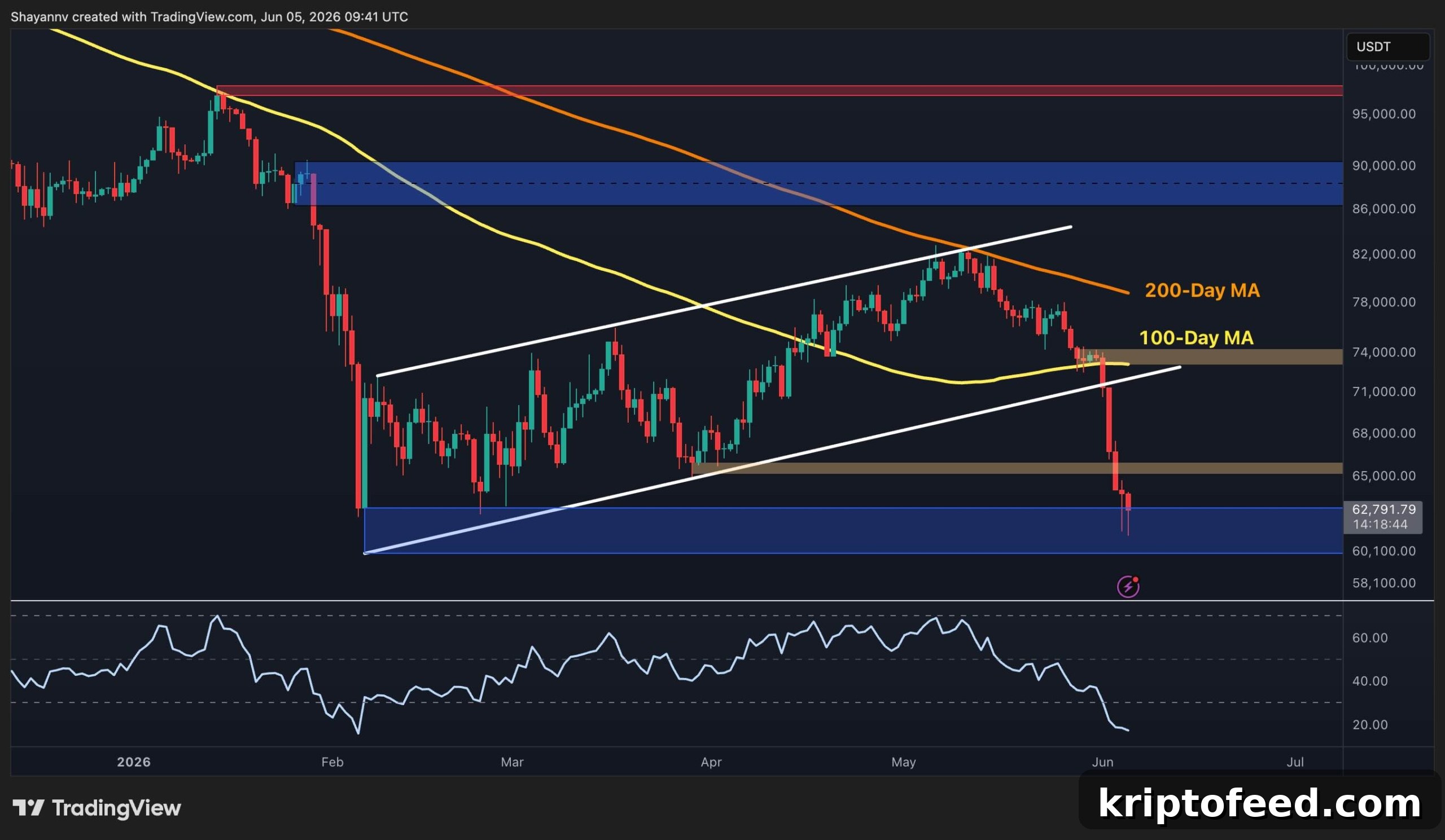
Bitcoin is under intense selling pressure after breaking down through several key support levels in rapid succession. A rejection at the declining 200-day moving average triggered a swift sell-off that invalidated the prior rising channel and pushed BTC back toward a major demand zone near $60,000. At the same time, on-chain indicators show an increasing number of market participants are realizing losses, underscoring weakening investor sentiment.
Bitcoin Price Analysis: The Daily Chart
On the daily chart, Bitcoin has confirmed a meaningful bearish breakdown after slipping under the ascending channel that had supported the recovery since February and falling below the 100-day moving average around $74,000. This break indicates buyers have ceded control of the intermediate trend.
The rejection came at the intersection of the channel’s upper boundary and the descending 200-day moving average near the $82,000 area. Since that point, BTC has experienced an aggressive decline, cutting through the $74,000 support zone and the important late-May low near $65,000 with little resistance.
Price is now testing a significant support block at $60,000, which previously served as a strong bounce area following the February capitulation. This zone currently represents the last substantial defensive line for bulls before the market would be exposed to substantially lower price levels.
BTC/USDT 4-Hour Chart
The 4-hour timeframe highlights the intensity of the recent decline. After a prolonged consolidation around the $74,000 region, BTC failed to reclaim that level and subsequently broke below the lower boundary of the daily ascending channel that had supported price action for months.
As the breakdown accelerated, the $65,000 support area also failed, driving price directly into the $60,000–$62,000 demand region. That zone is currently absorbing selling pressure and has attracted early buying interest that is preventing a deeper immediate fall.
An important technical observation is a mild bullish divergence on the RSI while conditions have become extremely oversold and price has made fresh local lows. Although this signal is still in its early stages, it suggests short-term bearish momentum may be easing and could support a temporary rebound toward the $65,000 resistance area.
Structurally, however, the market remains in a sequence of lower highs and lower lows. As long as Bitcoin trades below the former support levels at $65,000 and $74,000, any rallies are likely to be corrective in nature rather than the start of a renewed uptrend.
On-Chain Analysis
The Adjusted Spent Output Profit Ratio (aSOPR), which measures whether coins moved on-chain are realized at a profit or loss, is sending a notable signal about investor behavior.
The 30-day EMA of aSOPR has dropped below the key 1.0 threshold. Historically, values above 1 indicate that coins moved on-chain are being sold at a profit on average, while readings below 1 mean coins are being spent at a loss.
This recent decline beneath 1 has coincided with Bitcoin’s move toward the $60,000 area and reflects growing capitulation among holders. A larger share of investors are now exiting positions at a loss, a dynamic typically associated with bearish phases and reduced market confidence.
However, sustained readings below 1 can also mark the latter stages of a corrective move as weaker hands are pushed out of the market. Traders should therefore monitor whether aSOPR can recover above the 1.0 level; a rebound past that threshold would suggest profitability is returning across the network and could support broader market stabilization.
For the moment, both price action and on-chain data remain tilted in favor of sellers. The $60,000 support region is the critical battleground that will likely determine Bitcoin’s next major directional move, with a decisive break below it opening the path to lower targets, while a firm hold and aSOPR recovery could pave the way for a controlled recovery.