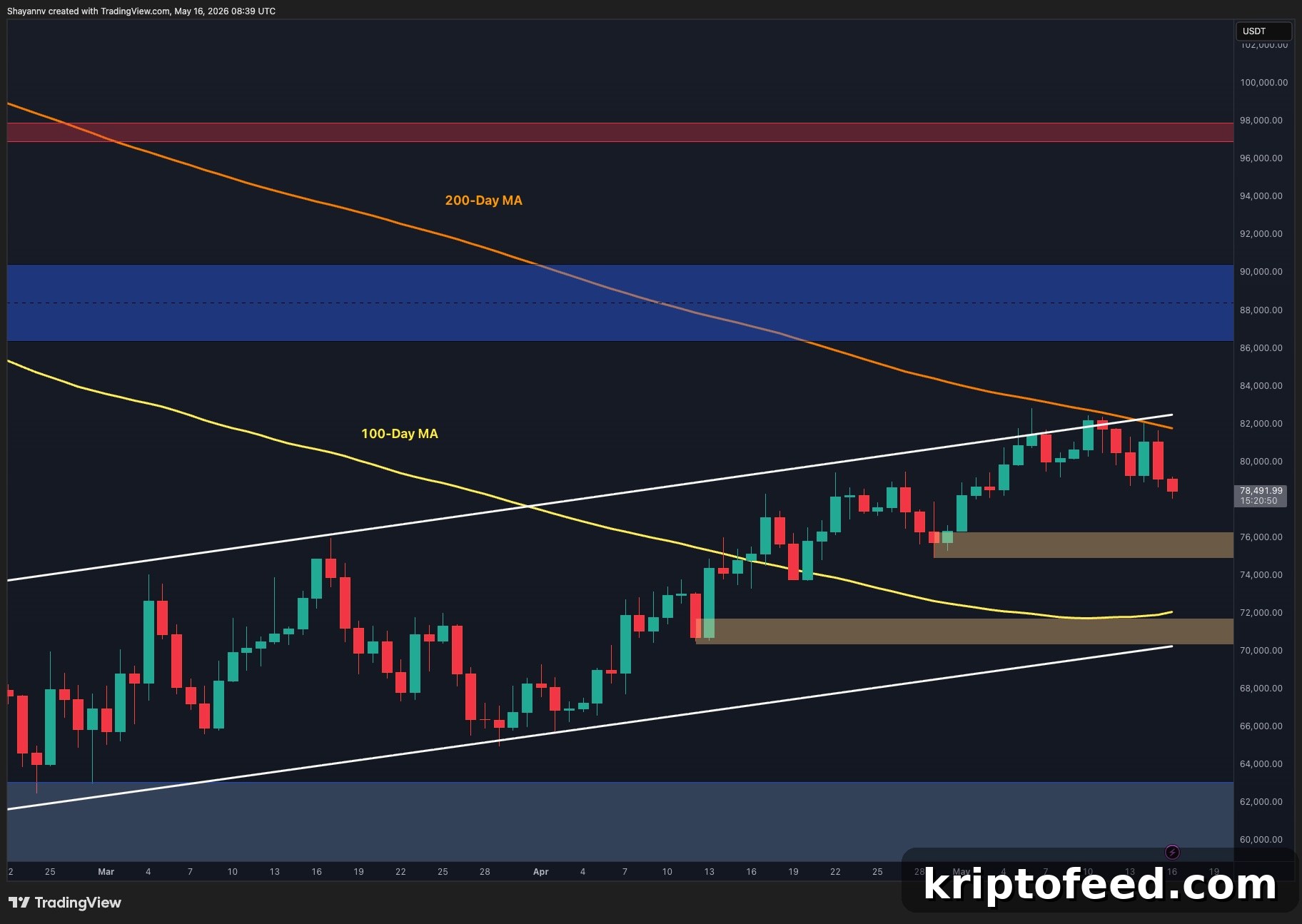
Bitcoin’s recent recovery attempt appears to be losing momentum after the market encountered another notable rejection below the $80,000 level. The repeated failure to hold gains above key thresholds suggests sellers still dominate, increasing the chance of another corrective phase in the near term.
Bitcoin Price Analysis: The Daily Chart
On the daily timeframe, BTC posted a modest bullish pullback following a rebound from the $78,000 support zone. That recovery, however, was rejected near the critical $80,000 resistance area, which also coincides with the descending 200-day moving average close to $82,000. The convergence of these resistance levels underscores their importance and highlights persistent bearish sentiment across the market.
The rejection in this area indicates buyers are not yet able to regain higher ground, while sellers continue to defend overhead supply aggressively. As long as Bitcoin remains capped below the $80,000–$82,000 region, the probability of an extended bearish retracement remains elevated. In that scenario, the first significant downside target is the demand zone around $75,000–$76,000. A deeper correction could ultimately expose lower support levels.
BTC/USDT 4-Hour Chart
Lower timeframes provide further confirmation of weakening momentum. Bitcoin recently broke below a key ascending trendline that had supported the latest recovery. More importantly, the subsequent pullback toward this broken trendline resulted in another rejection, effectively validating the initial bearish breakout.
This breakdown-and-retest pattern commonly signals continuation in the direction of the breakout, suggesting sellers remain in control. If bearish pressure persists, Bitcoin may continue declining toward the first important order block around $75,000–$76,000. Should that support fail to hold, selling could accelerate and expose the broader demand zone near $70,000–$71,000, which previously acted as a strong accumulation area.
Sentiment Analysis
The Coinbase Premium Gap measures the price difference between Bitcoin traded on Coinbase and other major exchanges, notably Binance. Because Coinbase activity is closely linked with U.S. institutional and spot investors, the metric is frequently used to gauge demand from American participants. Positive readings typically reflect stronger spot buying pressure, while negative readings often indicate weaker demand or increased selling.
Recently, the indicator slipped below the neutral zero line again, creating a negative premium gap. This shift suggests demand from U.S.-based investors is waning while selling pressure or cautious positioning is rising. Historically, sustained negative readings have often coincided with corrective phases or periods of weak momentum.
If the Coinbase Premium Gap remains below zero in the coming weeks, it could amplify the bearish technical picture seen on the charts and increase the likelihood of further downside pressure toward lower support zones.