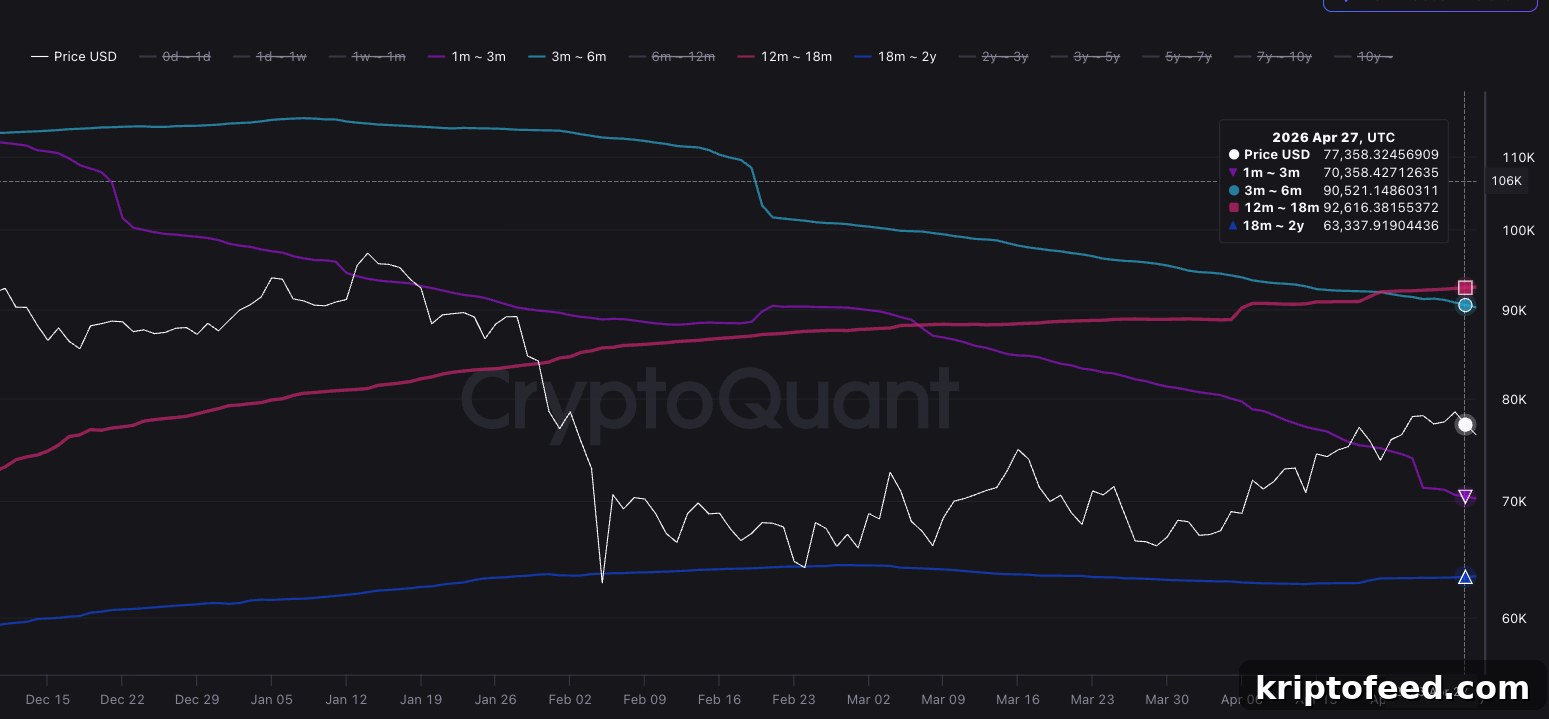
Bitcoin’s recent price action indicates the market is approaching a key decision area where technical and on-chain support levels converge. This convergence increases the chance of a short-term bullish response before the market determines its next larger directional move.
How price behaves around the $74,000–$75,000 support zone and deeper demand areas will likely shape Bitcoin’s medium-term outlook.
Bitcoin Price Analysis: The Daily Chart
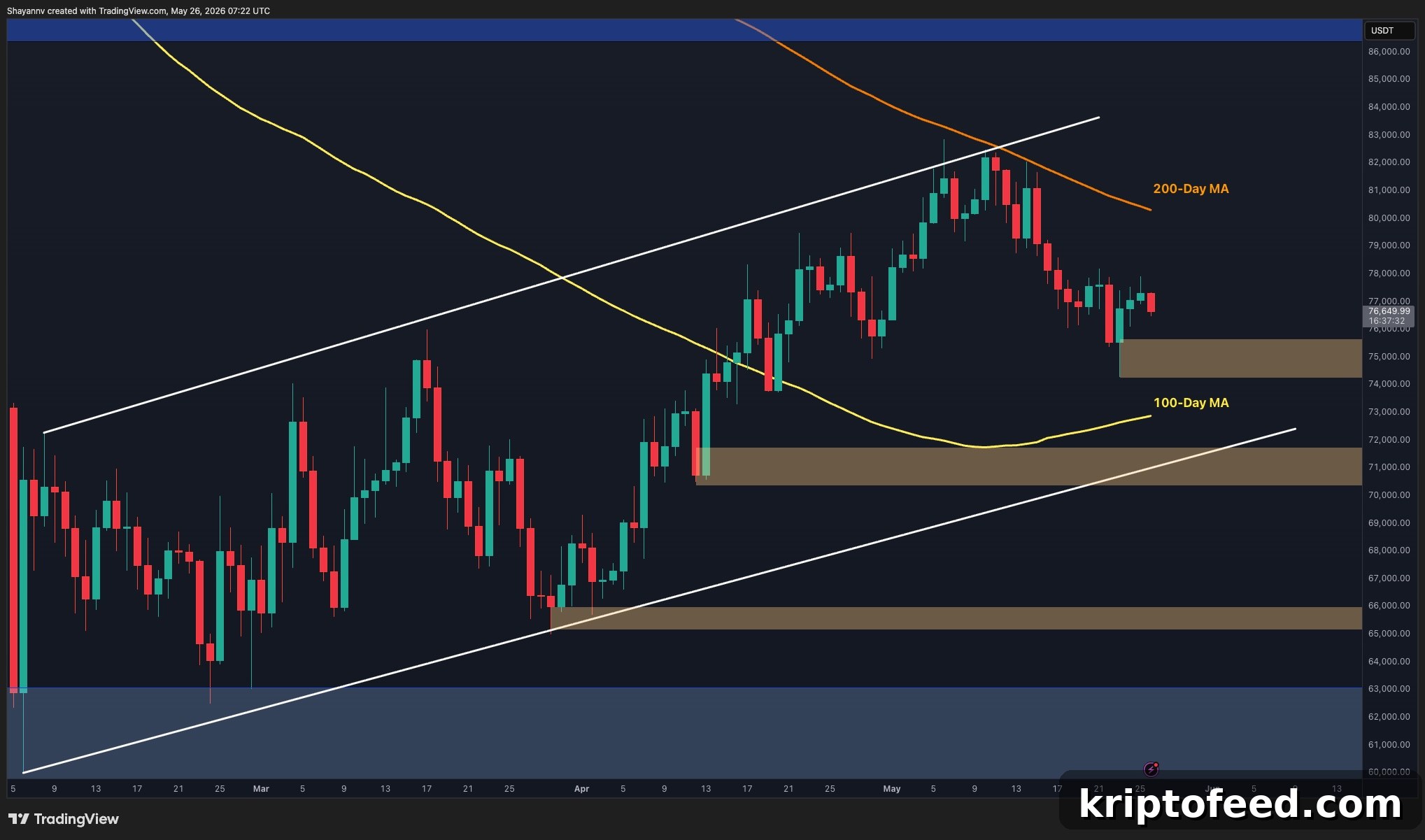
On the daily timeframe, Bitcoin remains below the descending 200-day moving average near $80,000 and is struggling to build convincing bullish momentum. After being rejected near the $82,000 resistance area, sellers pushed the market back toward the first major support band at $74,000–$75,000.
This zone is especially significant because it aligns with prior demand, recent local lows, and sits above the 100-day moving average near $73,000. Historically, overlapping support levels often produce temporary stabilization or corrective rebounds.
The immediate outlook favors a pullback toward the $74,000–$75,000 demand zone. If buyers successfully defend this region, Bitcoin could attempt another corrective move toward the $78,000–$80,000 area. However, losing the $74,000 level would expose the next key support around $70,000–$71,000, followed by stronger structural support near $65,000–$66,000.
At present, price action looks corrective rather than indicating a confirmed trend reversal.
BTC/USDT 4-Hour Chart
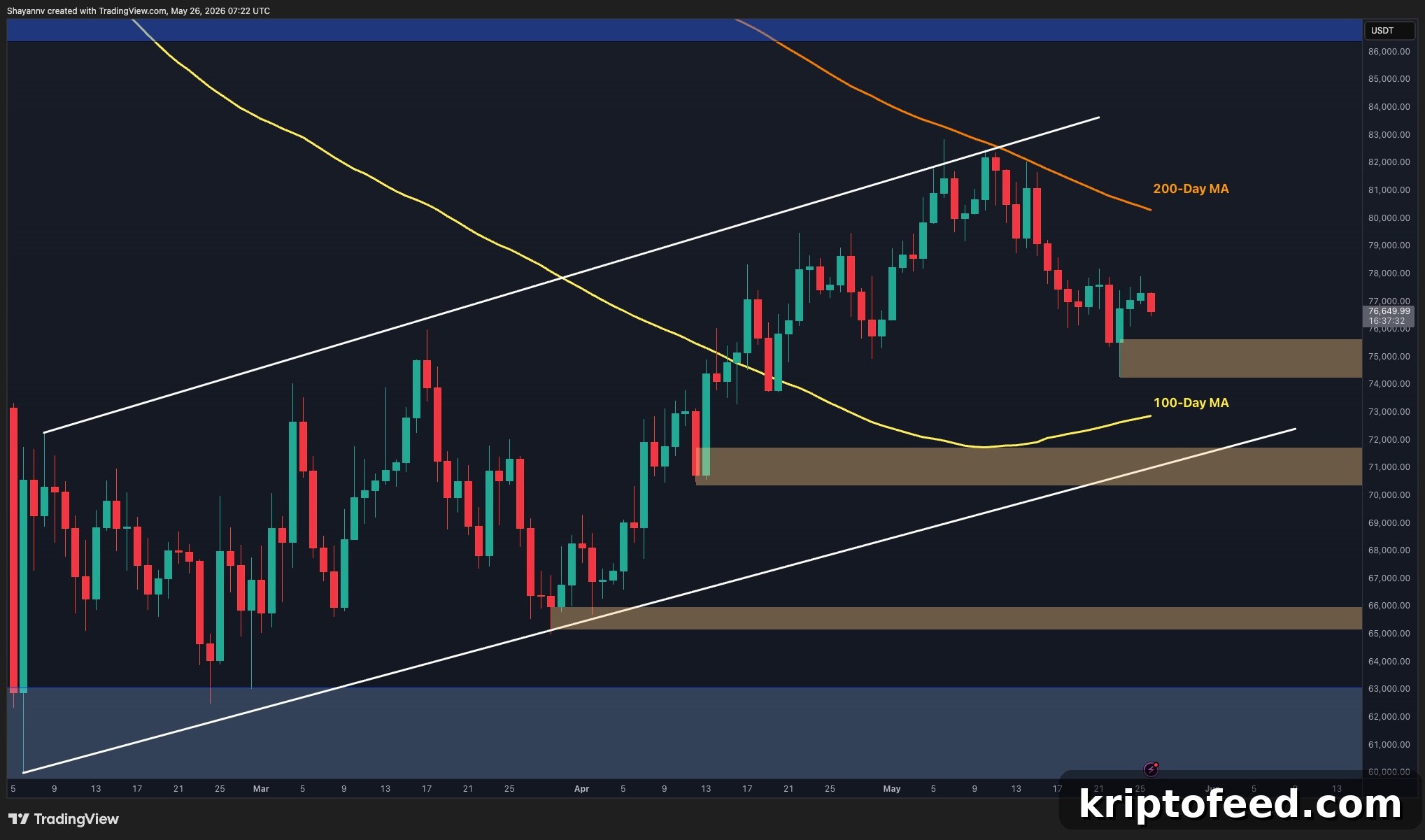
The 4-hour chart highlights growing indecision around support. Bitcoin recently reacted from the $74,000–$75,000 order block and briefly recovered toward $77,000, indicating buyers are still active in this area.
Nonetheless, bullish momentum remains weak, and rebounds have repeatedly failed to reclaim higher resistance levels. This pattern suggests current upward moves are more likely relief rallies than renewed trend continuation.
Short-term support is concentrated at $74,000–$75,000. Holding above this zone could prompt another recovery attempt toward $78,000–$80,000. Conversely, a confirmed breakdown below $74,000 would likely accelerate selling toward the next major demand area around $70,000–$71,000.
Therefore, how price reacts at current support levels will be critical in determining whether Bitcoin enters a stabilization phase or begins another bearish leg.
On-Chain Analysis
UTXO realized price bands add context by tracking the average acquisition cost of different holder cohorts. These bands often act as psychological support or resistance because they show where specific groups of holders move into or out of profit.
Currently, the realized price for the 1–3 month cohort sits near $70,000, while the 18–24 month cohort clusters around $63,000. Longer-term holders in the 12–18 month and 3–6 month brackets maintain realized prices closer to the $90,000 area.
The key point is the confluence between technical supports and realized price bands. Bitcoin’s first major support zone near $70,000–$71,000 aligns closely with the realized price of younger holders (1–3 months), which increases the likelihood of demand emerging there.
A deeper decline toward $63,000–$65,000 would coincide with the realized prices of longer-term cohorts and with an important historical daily support zone.
These relationships suggest that if the correction continues, the support levels at $74,000–$75,000, $70,000–$71,000, and ultimately $63,000–$65,000 could attract increasing buying interest. How the market reacts around those zones will determine whether the pullback evolves into accumulation or transitions into a broader bearish continuation.
For now, on-chain data point to short-term support potential rather than an immediate trend recovery.