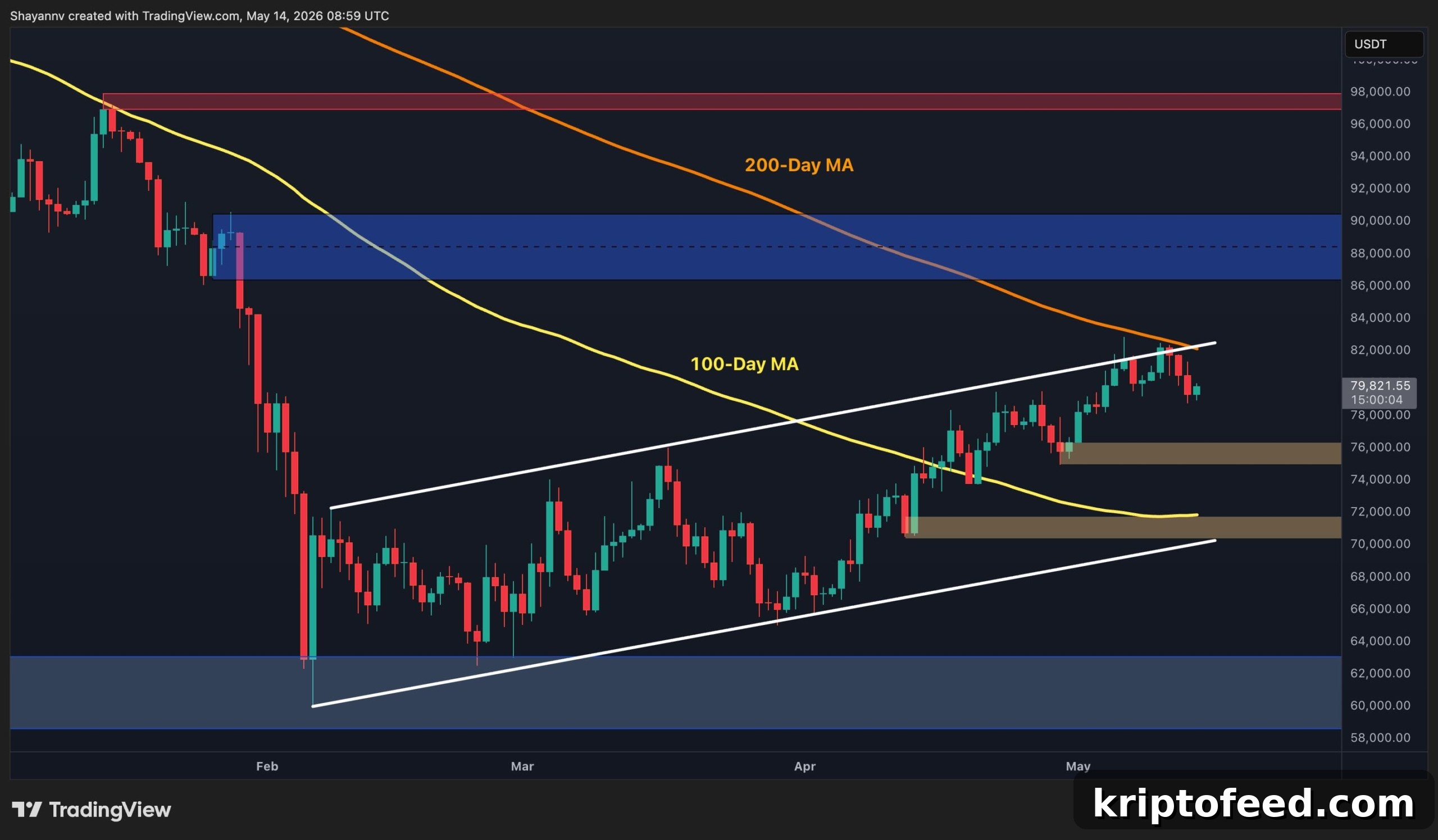
Bitcoin is showing early signs of weakness after its recent recovery toward the $80,000 resistance area. The market now faces a technically significant supply zone where sellers have become more active, increasing the likelihood of a broader short-term corrective phase.
Bitcoin Price Analysis: The Daily Chart
On the daily chart, BTC has displayed several bearish signals as price struggles to sustain bullish momentum around the critical $80,000 resistance level. This region aligns with a notable confluence of supply: the upper boundary of the larger ascending channel and the 200-day moving average near $82,000. The market’s repeated inability to reclaim this area underscores the presence of aggressive sellers and mounting distribution pressure.
Consequently, the odds of a larger bearish retracement have risen. If sellers retain control, Bitcoin could gradually move lower toward nearby support zones, with the $75,000 area serving as the first key demand zone. A deeper pullback would likely target the broader support band near $70,000–$71,000, which previously acted as a significant accumulation range for buyers.
BTC/USDT 4-Hour Chart
On the 4-hour timeframe, price recently broke below a key ascending trendline that had supported the latest bullish structure since the rebound from the $60,000 area. This bearish breakdown is an early warning that bullish momentum is fading and sellers are steadily gaining the upper hand.
Many traders who accumulated BTC during the capitulation toward $60,000 now appear to be taking profits and trimming exposure near resistance, which has amplified selling pressure around the $80,000 region. That behavior supports the likelihood of another corrective leg in the coming days. If bearish momentum accelerates, the market could decline toward the identified demand zones at $76,000 and, eventually, the $71,000 region.
Onchain Analysis
From a liquidation perspective, the Binance BTC/USDT heatmap shows a large concentration of liquidity below the current market price, especially around the $77,000 level. Historically, markets often move toward these high-liquidity zones because they can trigger larger directional moves through forced liquidations.
This increasing liquidity cluster beneath the market aligns with the bearish technical signals visible across multiple timeframes. As long as Bitcoin remains below the critical resistance confluence near $80,000–$82,000, the probability of a liquidity-driven decline toward the lower clusters remains elevated.
In summary, the technical and on-chain evidence points to elevated downside risk while BTC remains beneath the $80,000–$82,000 resistance zone. Traders should monitor key demand levels at $75,000 and $70,000–$71,000, alongside liquidity concentrations near $77,000, for potential support and the next directional cues.