
- Bitcoin price dipped to $62,800 amid renewed market weakness.
- Analysts say $60,000 is a key level for bulls in the short term.
- BTC could fall toward $50,000 if a bearish cross materializes.
Bitcoin’s price decline accelerated on Tuesday, sliding below $63,000 as the cryptocurrency remained sensitive to macroeconomic pressures and global uncertainties.
Trading volume jumped about 25% as investors reacted to several converging events, and major altcoins moved in step with Bitcoin’s losses.
Bitcoin falls under $63,000
Bitcoin extended losses to lows near $62,700 on Tuesday, marking almost a 29% drop over the past month.
The latest sell-off comes amid mounting worries over newly announced tariffs by President Trump, which have unsettled markets and filtered through to the crypto sector.
Analysts say these trade measures amplify concerns about inflation, trade instability and tighter global liquidity, all of which weigh on risk assets.
Heightened geopolitical tensions — including talk of potential U.S. strikes on Iran — have added to market fragility.
Bitcoin’s weakness has mirrored declines in traditional equity indices, which slid after research from Citrini triggered selling in delivery and payments firms while software stocks also weakened on Monday.
On-chain data further shows sizable ETF outflows, with investors withdrawing capital from crypto investment products across the market.
Data from Farside Investors indicate Bitcoin-focused ETFs recorded approximately $203.8 million in outflows on Monday.
Those headwinds have outweighed Strategy’s 100th Bitcoin purchase and have not been enough to halt the slide.
At the time of writing, BTC traded around $63,030, down roughly 2.4% over the past 24 hours.
The top cryptocurrency is about 7% below last week’s peak near $68,000.
What’s next for Bitcoin’s price?
This pullback refocuses attention on the important $60,000 support level.
Bears have already probed this psychological and technical floor, and BTC previously bounced from it after the February 5 crash.
Some analysts warn that further short-term weakness could push prices back toward $50,000 if selling accelerates.
In that event, additional lower supports would come into play as traders look for a base.
Conversely, certain chart patterns have historically signaled recoveries when long-term moving averages shift, though the current chart does not show a completed bullish cross; the 50-week moving average has not yet crossed below the 100-week average in a way that would reliably indicate an immediate bottom.
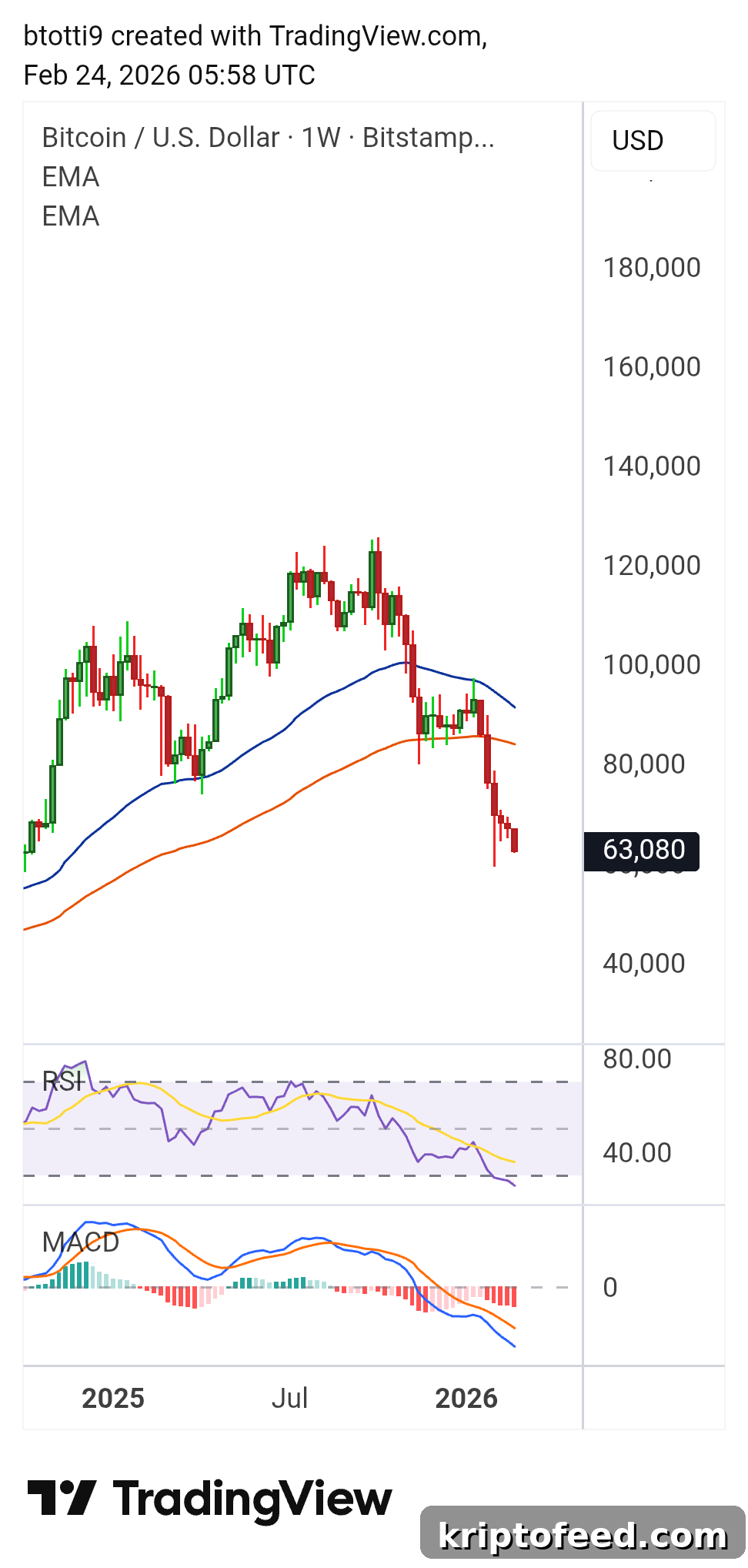
Although current signals point toward further downside, extreme oversold conditions could set the stage for a sharp rebound.
Bullish catalysts such as a shift in macro conditions or renewed ETF inflows could quickly alter the market’s trajectory.
The $70,000 level remains a critical threshold; a decisive break above it would likely accelerate a short-term recovery.
“For a durable breakout to materialise, the market will require a clear resurgence in spot demand and stronger institutional participation; until then, Bitcoin is likely to remain range-bound within its established absorption zone,” analysts at Bitfinex wrote in a research note.