
- Bitcoin price remains range-bound amid long-term holder selling and falling demand.
- U.S. Bitcoin ETF inflows point to cautious institutional optimism.
- Fed-related macro uncertainty and a government shutdown keep BTC under pressure.
Bitcoin (BTC) continues to navigate choppy market conditions as macroeconomic uncertainty and shifting institutional dynamics shape its short-term outlook.
Despite renewed investor interest and notable ETF inflows, the world’s largest cryptocurrency faces persistent downward pressure from long-term holder sell-offs, cautious institutional sentiment and a complex macro backdrop influenced by the Federal Reserve and an ongoing government shutdown.
Analysts and strategists are closely watching how BTC balances cyclical signals with broader market realities throughout November.
Bitcoin price struggles amid narrow trading range
Bitcoin’s price has largely been confined between USD 106,000 and USD 116,000 over the past two weeks, signaling consolidation rather than a clear bullish breakout.
Long-term holders have accelerated monthly distributions to roughly 104,000 BTC, marking one of the heaviest waves of sales since mid-July, according to a recent Bitfinex report.
This sustained selling pressure has coincided with weak institutional demand following October’s major liquidation event, leaving BTC stuck in a sideways range with few short-term catalysts.
Analysts warn that unless ETF inflows or fresh spot demand increase, the cryptocurrency could test support near USD 106,000, and a sustained break below that level could open the path toward USD 100,000.
ETF inflows signal cautious optimism
Despite these headwinds, U.S. spot Bitcoin ETFs have shown signs of recovery, injecting a degree of optimism into the market.
On November 11, U.S. spot Bitcoin ETFs recorded USD 524 million in cumulative net inflows.
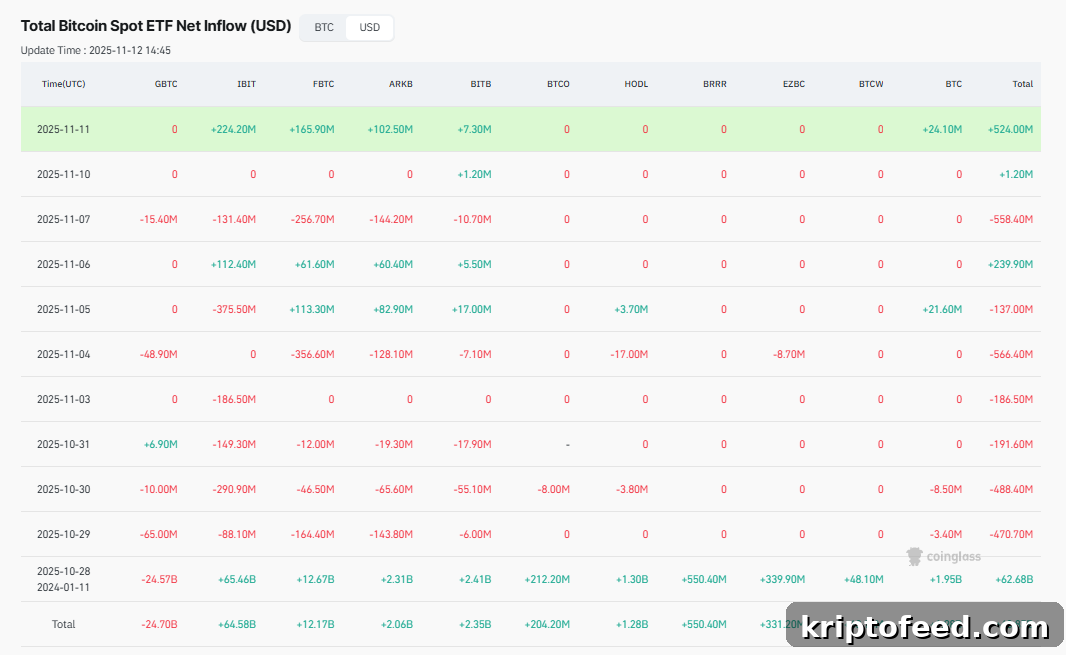 Total cumulative inflows into spot Bitcoin ETFs (USD) | Source: Coinglass
This return of demand, together with “smart money” traders adding net long positions totaling more than USD 8.5 million, highlights growing — if measured — confidence among institutional participants.
Analysts note that sustained ETF inflows could mark the end of the broader risk-off phase seen after the market drawdown, even as retail participation remains subdued.
Macro factors keep BTC on edge
Even with rising ETF inflows, macro conditions continue to weigh heavily on Bitcoin.
The recent 25 basis-point Fed rate cut and the formal end of balance sheet runoff are tempered by internal division over next steps, with some officials highlighting persistent inflation risks while others warn of labor market cooling.
At the same time, the secured overnight financing rate (SOFR) recently plunged to 3.92%, a move that financial analyst Shanaka Anslem described as evidence of market panic.
THE WORLD’S MOST IMPORTANT NUMBER JUST COLLAPSED
November 6, 2025: SOFR crashed to 3.92%. The lowest level in two years. The benchmark that controls $397 trillion in global contracts just signaled something catastrophic.
This is not a rate cut. This is a liquidity flood.
THE… pic.twitter.com/W5vmNRUXpq
— Shanaka Anslem Perera ⚡ (@shanaka86) November 9, 2025
These developments, coupled with declines in consumer confidence and slowing wage growth, have introduced uncertainty around short-term capital flows and investors’ appetite for risk assets like Bitcoin.
The ongoing government shutdown adds another layer of complexity. While the Senate moves toward a potential resolution, analysts caution that any relief may lift equities more than crypto, as capital could rotate back into traditional financial markets while liquidity remains on the sidelines awaiting normalized economic data.
That dynamic has contributed to continued downward pressure on BTC even as technical indicators and ETF signals point to potential stabilization.
Bitcoin price outlook for November
Looking ahead, November may not deliver the historical year-end rallies typical of the penultimate month, as BTC remains caught between conflicting forces.
ETF inflows and smart-money activity provide a foundation for renewed optimism, but ongoing distribution by long-term holders, macro uncertainty and cautious institutional behavior continue to weigh on Bitcoin’s price.