
The monthly close of the candlestick is one of the most useful tools for medium- and long-term technical analysis. March became one of the most turbulent and discouraging months in the history of global markets, prompting some traders to prepare defensive strategies while others seized buying opportunities. This article identifies key price levels for Bitcoin, Ethereum and Ripple as they navigate one of the most volatile and risk-prone periods since the COVID-19 pandemic began.
BTC/USD: Has Coronavirus radically changed the outlook?
Bitcoin began 2020 with a bullish technical bias supported by multiple signals, including a golden cross of moving averages and a roughly 50% rally. Yet panic affected Bitcoin as well, with nearly every financial instrument coming under pressure after the COVID-19 outbreak.
After a dramatic drop to around $3,900, Bitcoin staged a strong recovery of more than 65%, closing March at $6,438.64 according to average figures reported by CoinMarketCap.
Key points from the daily chart:
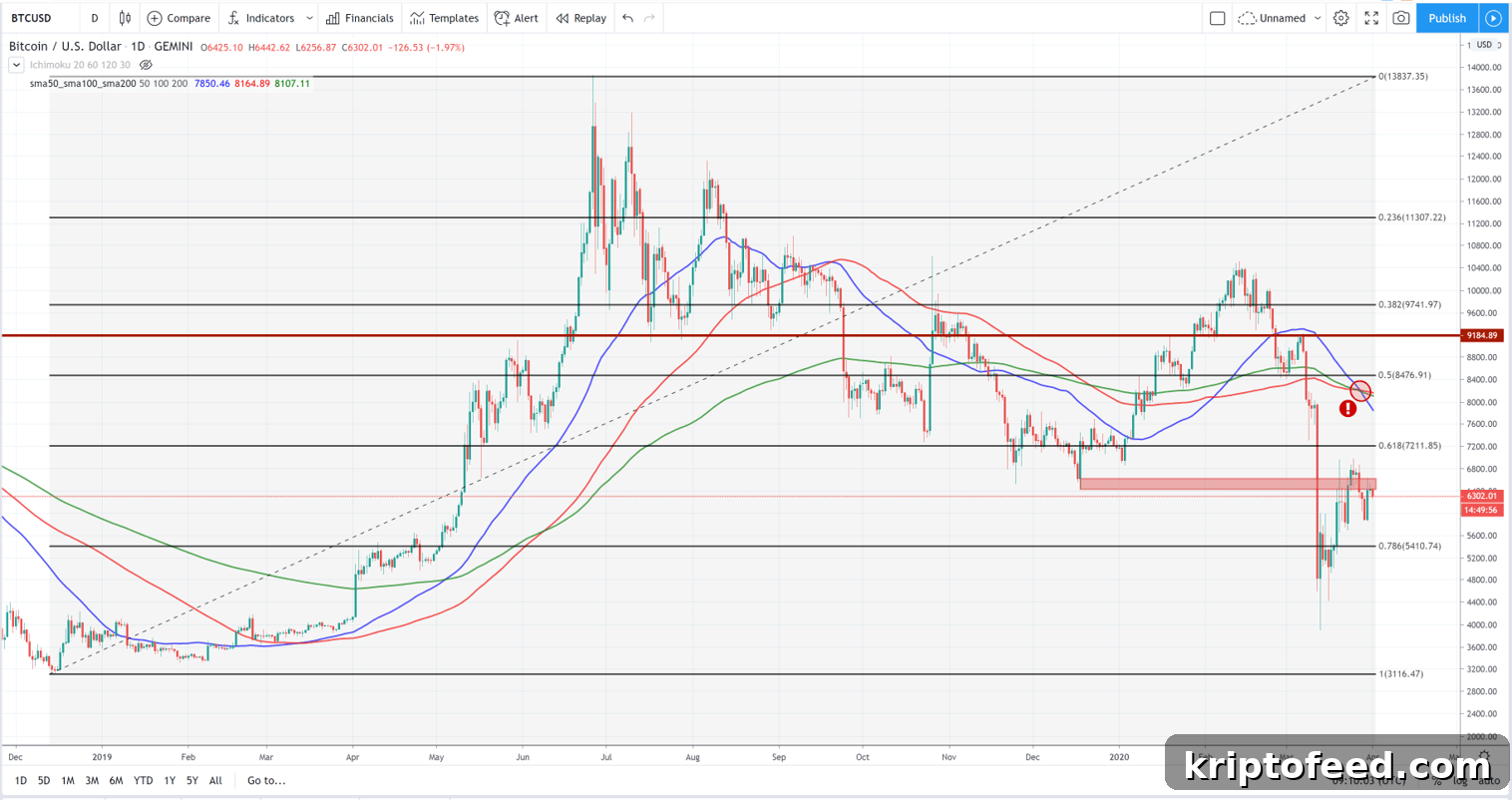
- An unexpected market reversal quickly invalidated the golden cross created by the 50- and 200-day simple moving averages on February 20.
- Despite the recent bounce, a death cross emerged last Friday. A death cross is a bearish indicator that has often signaled medium-term weakness.
- Fibonacci retracements outline broad support and resistance zones for Bitcoin, while short-term timing will require closer inspection on lower timeframes.
- BTC is currently trading in a resistance range between roughly $6,400 and $6,600. A sustained bullish push could target the next FIB resistance around $7,200.
- The upside faces clear resistance near $8,475, additional resistance around $9,200 (not from Fibonacci), and a psychological barrier at $10,000 where volatility often increases.
- On the downside, BTC could revisit the fragile area around $5,500 for support. If bulls fail to defend that zone, Bitcoin may test the early-year lows near $3,900 and potentially fall into the lower $3,000 range.
- Given heightened price swings and coronavirus-driven volatility, these technical scenarios are subject to change and require ongoing monitoring.
- Another important event is the upcoming Bitcoin halving, scheduled in roughly 42 days according to BitcoinBlockHalf, when miner block rewards fall from 12.5 BTC to 6.25 BTC. Historically, halvings have supported bullish trends by reducing new supply. Bitcoin’s deflationary issuance caps supply at 21 million BTC and cuts emission over time to support demand dynamics.
ETH/USD: Battling to stay in three figures
Ethereum, the second-largest cryptocurrency by market capitalization, plunged on coronavirus-driven FUD and briefly fell below the $100 mark. Despite solid fundamentals and development progress, Ethereum struggled to convince bulls amid a broadly negative economic backdrop.
Unlike Bitcoin, ether maintained the bullish golden cross, but the daily chart is currently outlining what looks like a bearish flag.
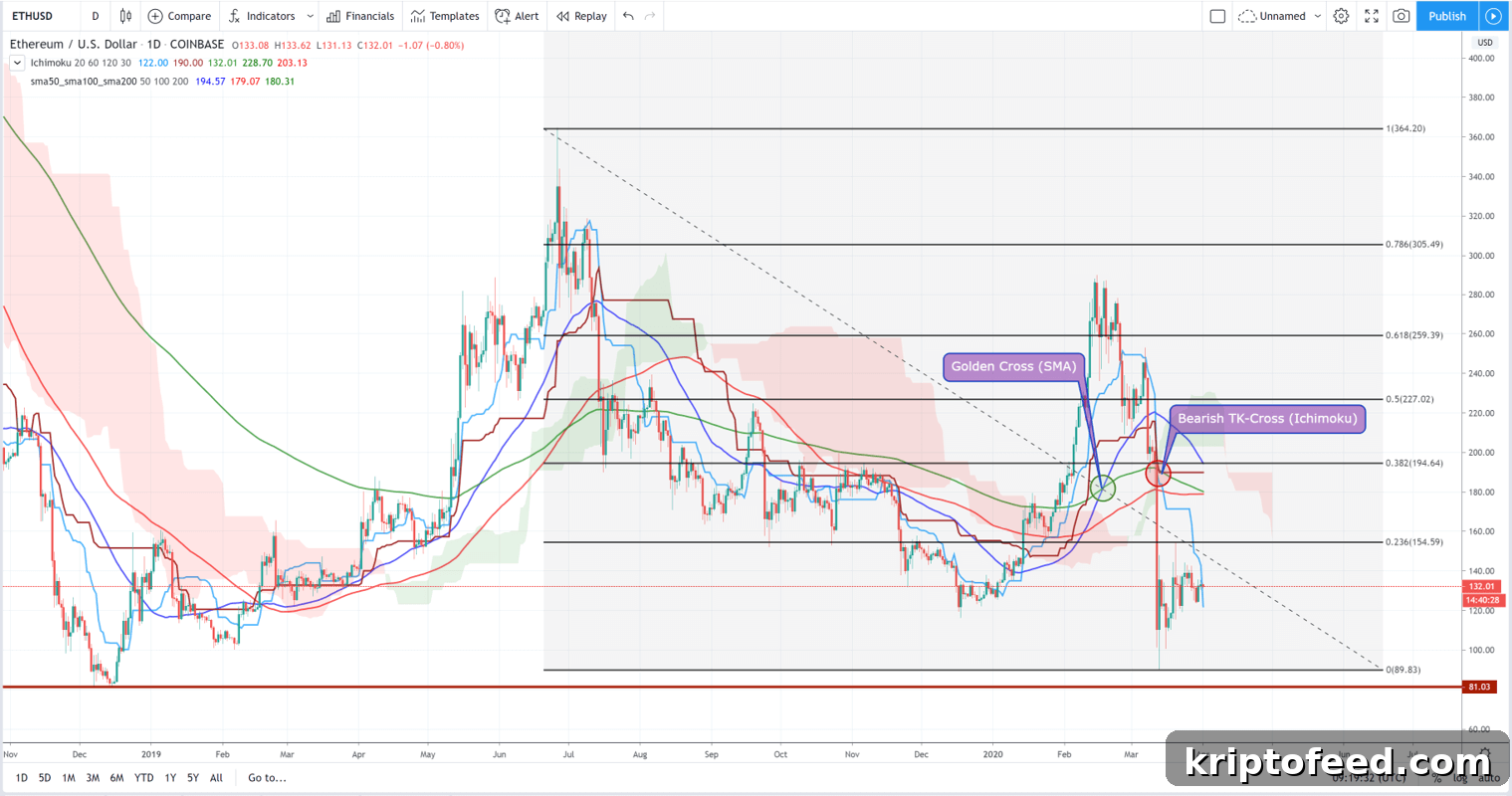
- ETH is trading in an accumulation zone around $120–$135, but the daily chart is forming a potential bearish cross.
- If confirmed, this signal could push ether back toward the year lows near $90. If that support fails, a re-test of the 27-month low near $81 becomes possible, though that remains a worse-case and less likely scenario.
- Fibonacci retracements mark the primary support and resistance levels to monitor through COVID-19 volatility. The nearest short-term resistance is clearly around $154.50.
- Breaking above $154.50 could open a move to the next resistance near $190. Intermediate levels to watch are defined by FIB retracements at $227, $259 and $305.
- Short-term levels are best refined using lower-timeframe analysis.
- Although the golden cross remains intact, the Ichimoku Cloud shows a bearish TK cross with the Tenkan-sen crossing below the Kijun-sen. Because the cross occurred above the Kumo cloud, the bearish bias appears relatively weak and may be temporary.
- Ethereum remains an important market to watch. A potential ETH 2.0 launch later this year could shift sentiment significantly and draw bulls back if the upgrade proceeds as planned.
XRP/USD: Stuck in a bearish stalemate
While Bitcoin and Ethereum showed bullish technical signals in recent months, Ripple appears stalled. XRP has formed a clear downtrend with lower lows since August 2019 and failed to break key resistances during the Q1 2020 rally.
XRP was less affected by the coronavirus crash than some peers. While others posted historic declines, XRP is roughly 18% below its price on March 12—the date of the global market sell-off. Key observations from the daily chart:
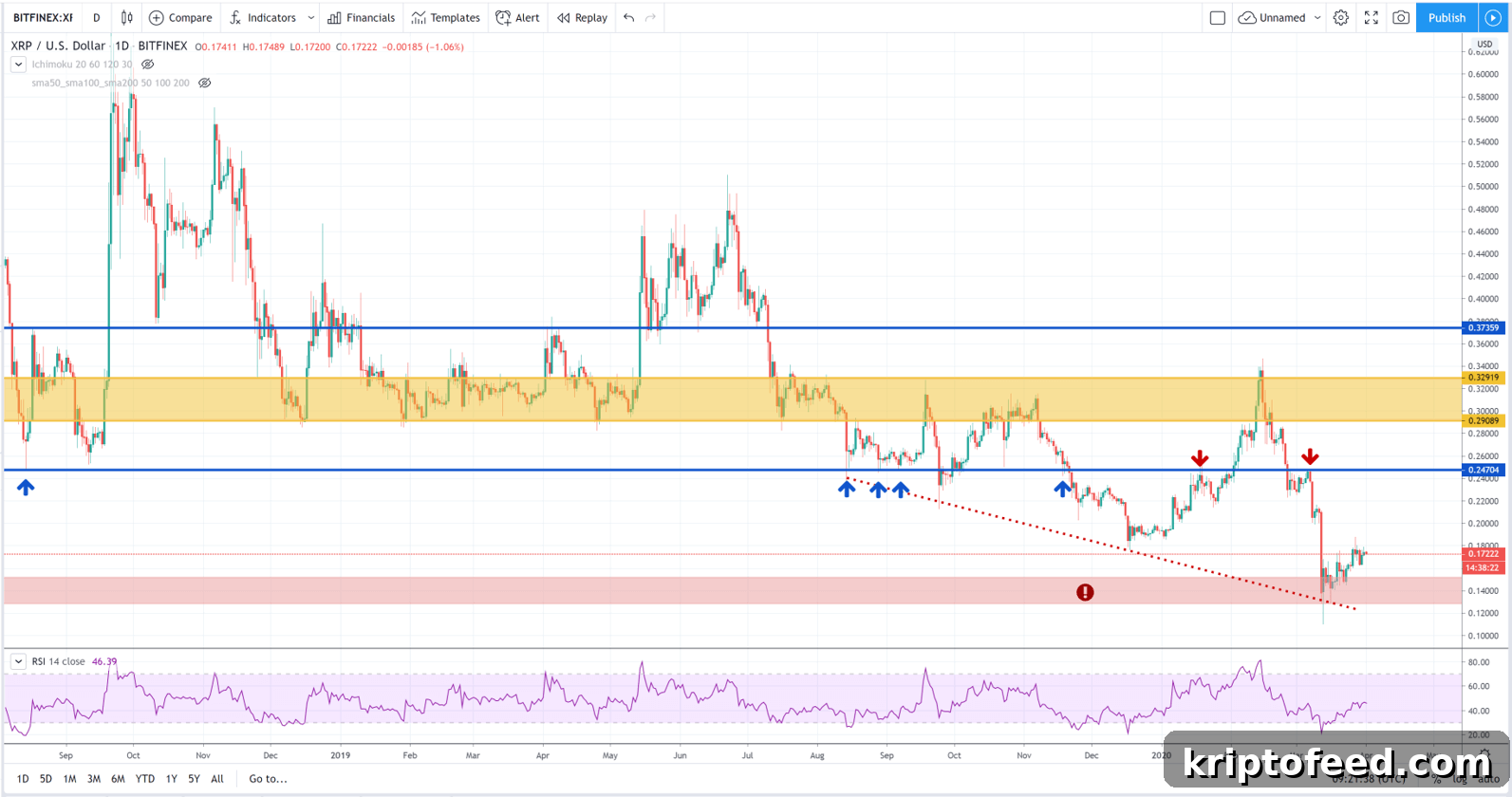
- Volatility reduces the precision of tools like Fibonacci retracements here, so traditional charting techniques are useful to identify levels.
- The clear support near $0.247 has become the first critical resistance after the recent sell-off.
- If bullish liquidity can push past that level, XRP may revisit an accumulation zone between $0.29 and $0.33, where it historically spends extended periods.
- Above that accumulation zone, the trading landscape becomes more contested with resistance near $0.37 and the psychological level of $0.50.
- If bears prevail, Ripple could fall back into the “danger zone,” retesting support near approximately $0.13.
- The Relative Strength Index (RSI) sits in neutral territory, indicating neither overbought nor oversold conditions—so a decisive move from bulls or bears is likely to determine the next direction.
Overall, COVID-19 has introduced exceptional volatility, making diligent monitoring and time-frame-sensitive analysis essential for traders and investors across these major cryptocurrencies.