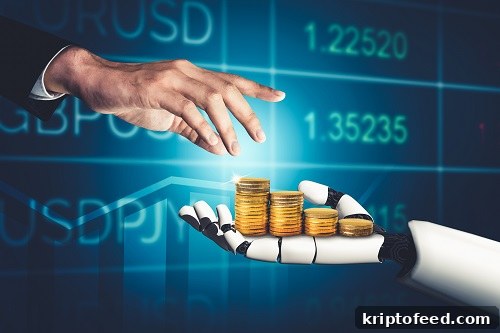
- The global AI market is forecast to grow to $1,394.30 billion in 2023.
- Investors and traders can leverage AI to benefit from automation, improved decision-making, and increased accuracy.
- Bitcoin and AI together can help reduce fraud and improve transaction security across global markets.
As technology advances, many wonder whether intelligent machines will replace humans, augment them, or combine with people to create a new hybrid that outperforms either alone. While that debate continues, one fact is clear: artificial intelligence is already deeply embedded in many industries, and its influence keeps expanding.
This article explores the intersection of Bitcoin and AI. For crypto enthusiasts and investors, AI can serve as a practical guide to understanding the market, risks, and opportunities within the digital asset landscape.
Key developments
Market research firm Fortune Business Insights projects that the global AI market will reach approximately $1,394.30 billion in 2023. AI’s capabilities—particularly pattern recognition and predictive analytics—are expected to deliver better outcomes for cryptocurrency investors by helping to anticipate market trends and price movements more effectively than traditional methods.
When combined with Bitcoin and other cryptocurrencies, AI can play a crucial role in combating fraud, expediting transaction processing, and strengthening overall security. In an ecosystem where scams and hacks remain persistent threats, AI-powered monitoring and anomaly detection systems can help protect assets and minimize losses.
Fraud and cyberattacks have long been among the biggest dangers in the crypto sector. Victims of such incidents often suffer severe financial and reputational damage. Deploying AI-driven surveillance and defense mechanisms can create a more resilient environment for digital currencies, enhancing trust and stability across networks and exchanges.
AI also powers a range of trading products and services that give crypto investors an edge. For example, automated trading bots use machine learning, deep learning, and other AI techniques to analyze market data, recognize patterns, and execute trades at speeds impossible for human traders. Beyond price prediction, these tools aggregate news, identify emerging trends, and provide actionable insights about the broader crypto landscape.
Despite these advantages, significant challenges remain. Public perception varies widely: some believe cryptocurrencies could replace traditional fiat currencies, while others point out that a lack of regulatory clarity and limited mainstream acceptance by major corporations hinder that outcome. The inherent volatility of cryptocurrencies makes precise forecasting difficult; even the most advanced AI models can only improve probabilities, not guarantee certainty.
Moreover, as defensive technologies improve, attackers evolve their tactics. Crypto trading remains an attractive target for bad actors, and AI will be used on both sides—by defenders to detect and prevent attacks, and by attackers to develop increasingly sophisticated exploits. Ongoing vigilance and continuous improvement of security systems are essential.
Positive signals
AI is reshaping finance, and crypto trading is one area poised to benefit significantly. Advanced analytics, automated tools, and faster, more reliable transaction monitoring can all help traders and institutions extract greater value from digital assets.
The technological foundation of the crypto market is strengthening. After a difficult 2022 for many digital assets, innovations in AI and infrastructure could support a recovery and renewed interest in the space. Demand for crypto remains resilient in many regions, suggesting continued relevance and growth potential.
Wider adoption by major companies and financial institutions would accelerate this transformation. Several firms have expressed growing interest in crypto and blockchain technology, and as more reputable organizations embrace these tools, the market’s maturity and utility will improve.
Final thoughts
The combination of Bitcoin and AI is generating considerable attention because both bring innovative capabilities to the digital economy. AI extends across business functions, bringing automation, insight, and risk management, while cryptocurrencies like Bitcoin offer novel approaches to value transfer and financial inclusion.
Together, they can produce tangible benefits: improved market analysis for investors, enhanced transaction security, and more effective monitoring of illicit activity. AI-driven trading bots and market intelligence services provide traders with faster alerts, research, and execution—helping them respond more rapidly to changing conditions.
Public opinion and institutional support will strongly influence whether cryptocurrencies can grow into mainstream alternatives to fiat money. Negative commentary from influential voices can stall adoption, while positive endorsements and practical use cases can accelerate acceptance and integration.
For traders seeking platforms and tools, many reputable services now combine AI capabilities with crypto trading features to help users navigate this fast-moving market. Exploring those platforms and learning how AI can support your strategy may be a practical step toward gaining more control and confidence in crypto investing.