
- The largest theft amounted to $91.4 million from anonymous Bitcoin addresses.
- Other victims included Odin.fun ($7 million), BetterBank.io ($5 million) and CrediX Finance ($4.5 million).
- Weak audits, human error and rapid platform launches are creating security risks.
The digital asset industry took another hit in August when hackers stole $163 million in 16 separate incidents, according to blockchain security firm PeckShield.
This marks an increase from July’s $142 million, highlighting that attacks are both becoming more frequent and more technically sophisticated.
The single largest heist—$91.4 million—originated from multiple anonymous Bitcoin addresses, underscoring the vulnerability of individual investors and institutions alike.
Beyond immediate financial losses, these breaches raise questions about the safety of centralized platforms and their potential long-term effect on investor confidence across the rapidly expanding global crypto markets.
$54 Million BtcTurk Hack Exposes Exchange Weaknesses
One of August’s most significant incidents involved a breach at Turkey’s leading crypto exchange, BtcTurk, which lost $54 million.
This event was particularly notable because the same platform had already been hit in June 2024 for another $54 million, pushing its total annual losses above $100 million.
BtcTurk confirmed unauthorized access was detected, affected wallets were frozen, and investigations with local authorities are underway.
The recurrence of the attack highlights how centralized exchanges remain prized targets, and that existing security defenses can be insufficient against persistent attackers.
Other Platforms Lost $17 Million in Separate Incidents
While BtcTurk dominated headlines, smaller but still damaging hacks struck other platforms. Odin.fun lost $7 million, BetterBank.io suffered $5 million in losses, and CrediX Finance was drained of $4.5 million.
These cases show cybercriminals target not only major exchanges but also smaller platforms, frequently exploiting weak security audits or systems that haven’t been thoroughly tested.
The cumulative impact of these breaches demonstrates that no level of the crypto ecosystem is immune to exploitation—whether due to technical vulnerabilities or fundamental operational oversights.
Human Error and Inadequate Audits Fuel Rising Attacks
PeckShield’s data indicate the sector’s rapid expansion is directly linked to the increase in hacks. New platforms and protocols are often launched quickly without comprehensive security audits, providing attackers with multiple entry points.
Alongside structural weaknesses, human error remains a major factor. Users who don’t enable two-factor authentication, rely on weak passwords, or fall victim to phishing scams leave both exchanges and personal wallets exposed.
The combination of technical shortcomings and behavioral mistakes creates an environment where cybercrime thrives, forcing exchanges and investors to rethink their defensive strategies.
Regulators across multiple jurisdictions have taken notice of these trends and are calling for tighter compliance and more rigorous security checks.
Bitcoin Drops as Investor Confidence Wavers
The impact of these hacks has rippled across broader markets. Bitcoin (BTC) fell 0.29% over the past 24 hours, trading at $108,361.50, with a market capitalization of $2.15 trillion.
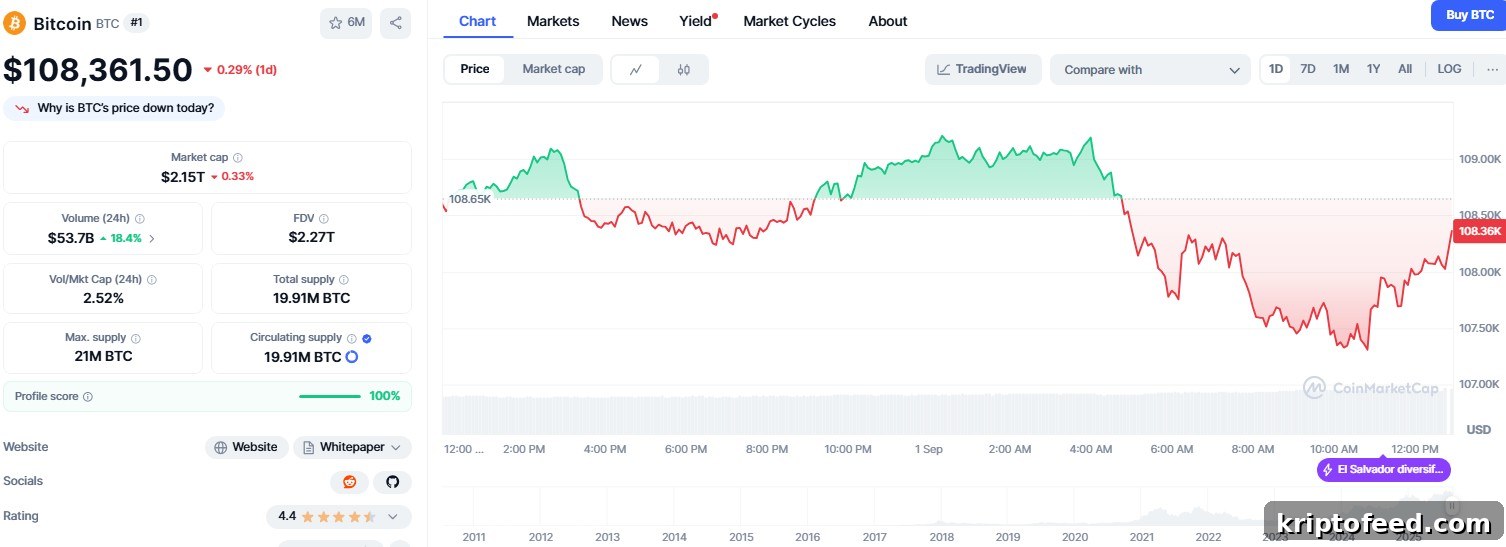
Analysts warn that repeated breaches could slow mainstream adoption, as each incident erodes investor trust and prompts stricter regulations intended to protect consumers and stabilize trading.