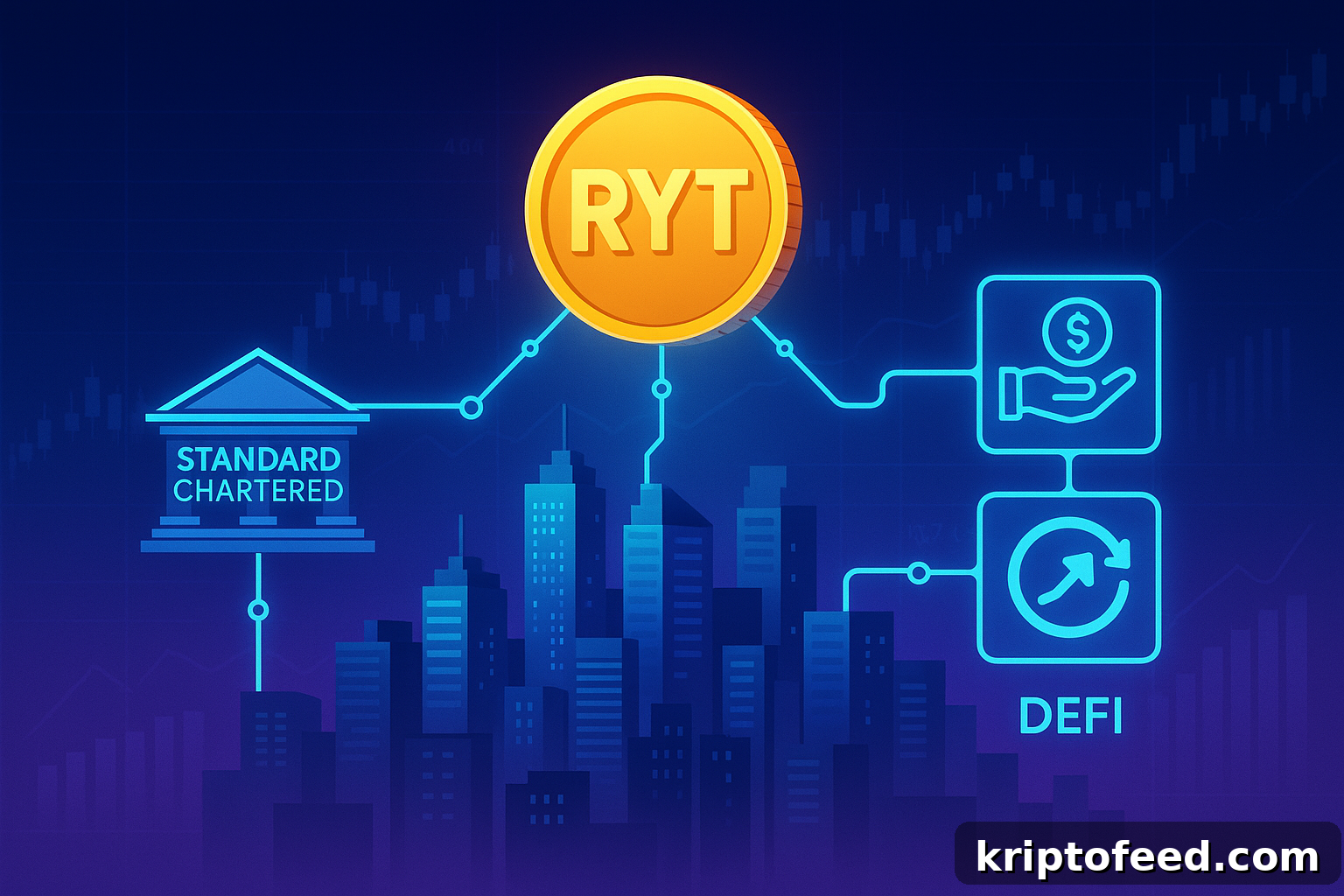
- AlloyX unveils a tokenized money market fund called RYT on Polygon to enable DeFi trading and yield looping.
- RYT holds bank-custodied assets with Standard Chartered, and the fund is regulated and audit-compliant.
- Tokenized money market funds are gaining traction as institutions and retail bridge traditional finance and DeFi.
AlloyX, a firm focused on tokenization infrastructure, has launched a tokenized money market fund on the Polygon network, reflecting the growing movement to bring real-world assets (RWAs) onto blockchain ecosystems.
The fund, named Real Yield Token (RYT), aims to combine traditional bank-custodied assets with decentralized finance (DeFi) strategies to provide investors with familiar cash-management characteristics alongside blockchain-native utility.
RYT blends conventional money market safety with DeFi flexibility
RYT represents shares in a conventional money market fund whose underlying assets are custodied by Standard Chartered Bank in Hong Kong.
The fund operates under applicable regulations and undergoes regular audits, offering investors transparency and compliance assurances.
Like traditional money market funds, RYT invests in short-dated, low-risk instruments such as U.S. Treasury bills and certificates of deposit, prioritizing capital preservation while producing modest returns.
However, tokenization adds new functionality that differentiates RYT from off-chain counterparts.
Holding RYT tokens allows investors to trade their shares on-chain and to integrate them into DeFi protocols, enabling the use of fund shares as collateral within decentralized applications.
Through a DeFi technique often called looping, investors can borrow against their RYT tokens and redeploy the borrowed proceeds back into the fund or other yield-generating strategies to amplify returns — a capability generally unavailable with traditional money market products.
AlloyX chose Polygon for distribution, citing the network’s low fees, fast transaction speeds, and a vibrant DeFi ecosystem that supports composable financial services.
Institutional interest in tokenized money market funds is rising
AlloyX is entering a rapidly expanding segment of the market.
Major financial institutions have increasingly explored tokenized money market funds as a way to combine the stability of cash-like assets with the efficiency and composability offered by blockchain technology.
Notable examples include BlackRock’s USD Institutional Digital Liquidity Fund (BUIDL), which provides tokenized exposure to U.S. dollar liquidity through Treasury bills and repurchase agreements.
Other large firms such as Goldman Sachs and BNY Mellon have announced plans for similar tokenized money market products. Many of those institutional offerings have initially focused on tokenization without exposing shares to DeFi-native operations like looping or deep composability, which helps distinguish AlloyX’s RYT.
A June report from Moody’s described tokenized short-term liquidity funds as a “small but fast-growing product,” estimating the market has reached roughly $5.7 billion since 2021. This growth highlights rising institutional appetite to bridge traditional finance and digital markets while providing investors access to well-understood, low-risk instruments in on-chain form.
Tokenized money market funds fill cash-management needs in DeFi
The growing adoption of tokenized money market funds is also linked to broader crypto ecosystem developments, including regulatory progress in the U.S. and increased stablecoin usage.
These factors have driven demand for on-chain products that retain the liquidity and safety characteristics of cash-like assets while remaining accessible and composable within decentralized protocols.
JPMorgan strategist Teresa Ho told Bloomberg that tokenized money market funds offer a practical alternative to posting cash or Treasury bills directly into DeFi. “Instead of posting cash or Treasuries, you can hold money market shares and not forfeit the yield in the meantime. That speaks to the versatility of money market funds,” she said, underscoring the appeal of products like RYT to investors seeking both yield and utility.
AlloyX’s launch marks a notable milestone for tokenized finance. It demonstrates how traditional instruments can coexist with decentralized protocols while unlocking innovative ways to generate yield through composability and permissionless access.
As demand for real-world assets on-chain continues to grow, tokenized products such as RYT could become an important bridge between conventional finance and DeFi. They may attract both institutional and retail investors seeking secure, liquid, and composable on-chain assets that mirror familiar cash-management solutions while offering new routes to enhance returns.