- Modernization introduces unified liquidity hubs to replace fragmented markets.
- Spokes introduces modular lending arrangements with independent risk profiles.
- V4 aims to improve capital efficiency and open new opportunities for developers.
The Aave lending protocol is preparing for one of its most significant upgrades.
Two days after unveiling a mobile savings app, the team released a testnet that signals progress toward Aave V4, an update designed to change how liquidity moves within the protocol.
Aave V4 testnet, featuring a developer preview of our new interface, Aave Pro, is now live. pic.twitter.com/q7ltPy0pxC
— Aave (@aave) November 19, 2025
V4 replaces the current multi-market system with an innovative unified “Hub and Spoke” architecture.
Version 4 is intended to transform how decentralized finance lending operates, prioritizing developers who want to launch risk markets or experiment with assets that don’t fit neatly into Aave’s existing structure.
The official blog emphasized:
Every L1 or L2 will have at least one Aave V4 Liquidity Hub, with the potential for multiple Hubs on a given network. Hubs enable greater experimentation in those ecosystems without liquidity becoming a limiting factor. This design makes it easier to support new risk profiles and allows innovation without fragmenting liquidity, while also providing a mechanism to seed liquidity for new Spokes.
To understand why the V4 upgrade matters, it helps to look at how Aave V3 works and the challenges that pushed the team toward a more flexible model.
A look at Aave V3
In Aave V3, each market operates independently.
Deployments such as Ethereum Prime and Ethereum Core maintain separate asset lists and liquidity pools.
Users supply assets to a specific market and can borrow only from that market’s pool.
While this structure helps isolate risk, it also creates important limitations.
For example, liquidity locked in one market cannot support lending in another market.
Building new markets also requires funding from scratch.
These constraints slow adoption and fragment the user base.
Additionally, governance and experimentation become more complex, because each market requires its own configuration.
The Aave team added:
It also limits the benefits of scale for lending and makes it harder to support new assets or implement unique loan configurations that end up isolated and less usable.
Unified liquidity hub to replace independent markets
Version 4 reimagines Aave’s lending ecosystem with the Liquidity Hub—a pooled source of assets for the entire platform.
The Hub serves as a single liquidity source so borrowers and suppliers draw from the same capital base, replacing segmented pools.
Importantly, users will not interact directly with the Hub, even though all deposits ultimately flow into it.
The Hub manages core functions including interest calculations, accounting, and credit limits.
Each L1 or L2 can host at least one Hub, with additional Hubs possible for chains with specialized needs or very high traffic.
The team expects this consolidation to significantly improve capital efficiency by reducing idle liquidity and enhancing borrowing conditions.
Outlook for AAVE
The native Aave token experienced notable selling pressure on its daily chart.
Over the past 24 hours it fell more than 6% to $166.
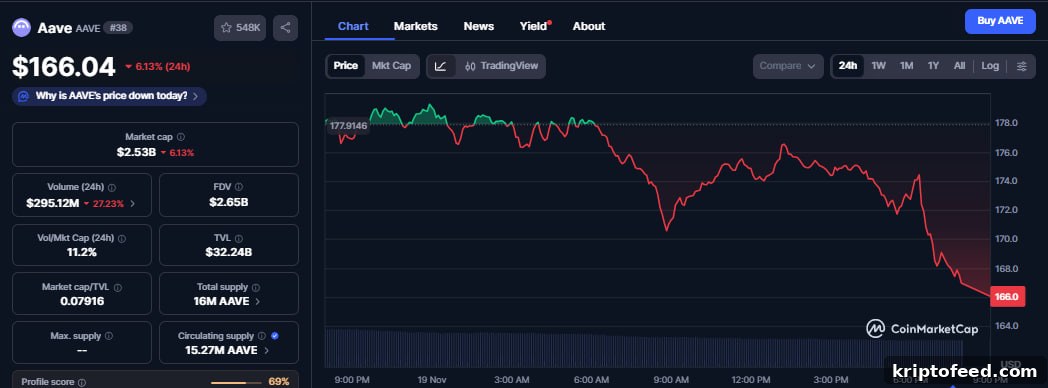
A 27% decline in daily trading volume confirms a bearish mood for AAVE.
Its weakening trend coincides with broader market softness.
The global cryptocurrency market capitalization dropped more than 4% in the last day to $3.04 trillion, while Bitcoin slid below $90,000 and traded around $89,478.