
Key takeaways
- BTC fell for a fourth consecutive day on Monday after a nearly 6% drop last week.
- US-listed BTC spot ETFs saw weekly outflows of about $1 billion, the largest since late January.
Bitcoin (BTC) remained under pressure on Monday, trading below $77,000 after a near 6% decline the previous week. Continued outflows from spot ETFs and hotter-than-expected US inflation data weighed on risk appetite and contributed to the pullback.
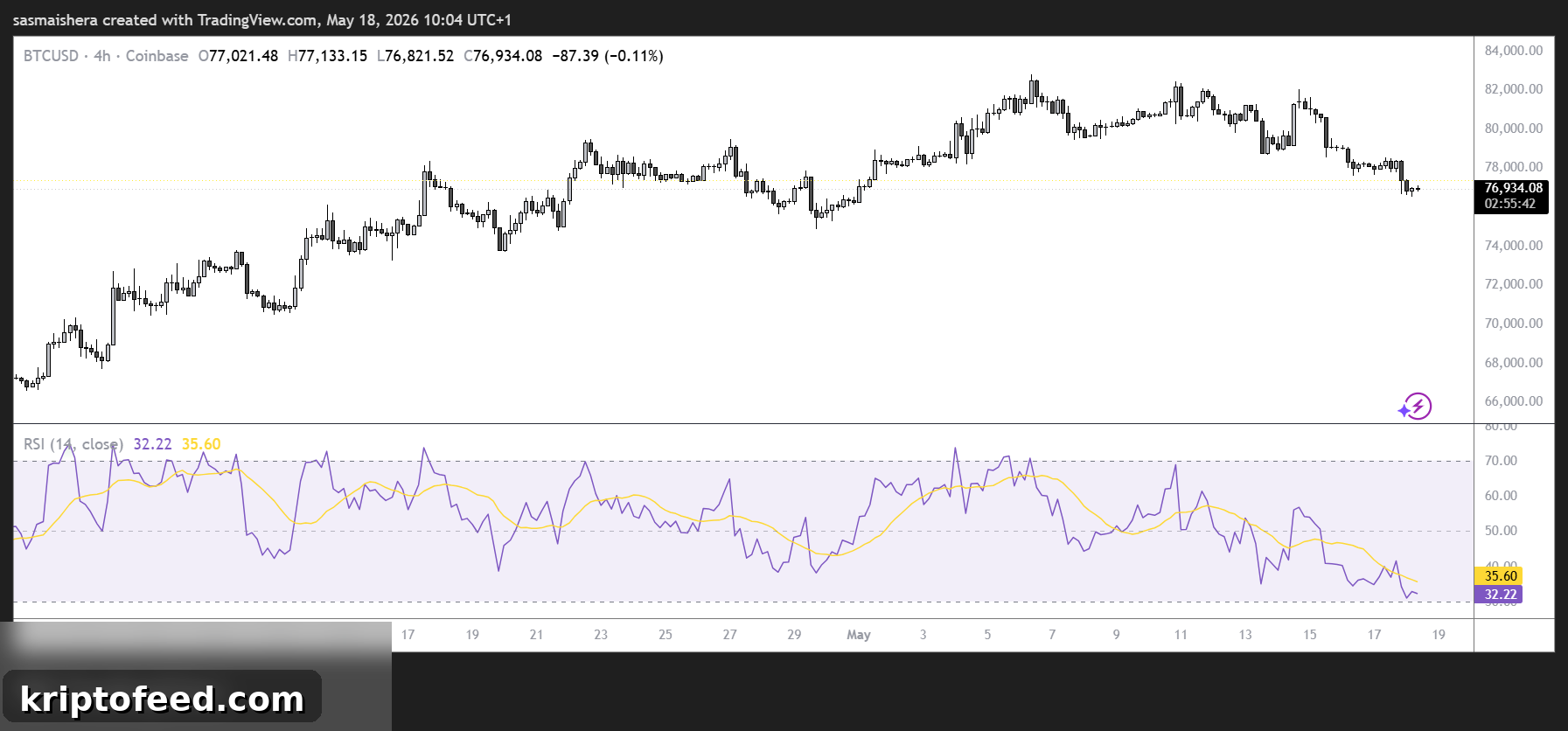
This marks Bitcoin’s fourth straight day of losses, extending the retreat after bulls failed to hold momentum above the key $82,000 resistance area.
Hot US inflation data boosts hawkish Fed expectations
Stronger-than-expected US inflation figures released last week, together with robust retail sales, reinforced expectations for a more hawkish Federal Reserve. Those developments strengthened the dollar and pushed Treasury yields higher, creating headwinds for risk-sensitive assets like cryptocurrencies.
Higher rate expectations tend to reduce liquidity and redirect capital toward safer, yield-bearing instruments, which can limit demand for speculative markets including Bitcoin. The failed advance near $82,000 also prompted profit-taking among short-term holders, amplifying the correction.
Institutional demand softened notably as well. Data from CoinGlass showed US spot Bitcoin ETFs experienced net outflows of roughly $1 billion over the week — the largest weekly withdrawal since late January. That shift in ETF flows signals cooling institutional sentiment after prior weeks of strong inflows that had supported the rally.
Analysts warn that continued ETF outflows in the coming sessions could exert further downward pressure on Bitcoin’s price.
Bitcoin price outlook: Bulls failed to take out a key resistance level
Technically, BTC/USD on the 4-hour chart turned bearish after price rejection near the 100-week Exponential Moving Average (EMA) around $82,289. Bitcoin also closed the week below the 61.8% Fibonacci retracement near $78,490, measured from the October all-time high of $126,199 to the February low around $60,000.
The breakdown beneath those technical levels has shifted momentum lower. If selling pressure persists, Bitcoin could extend losses toward the psychological support region at $75,000.
On the weekly chart momentum indicators have grown cautious. The Relative Strength Index (RSI) slipped below the neutral 50 mark and sits near 35, pointing to strong bearish momentum. The Moving Average Convergence Divergence (MACD) histogram is also in negative territory, signaling that bears are in control.
Immediate technical support lies near clustered 50-day and 100-day EMAs below the current price. Further downside targets include the 38.2% Fibonacci retracement near $74,487 and the previous trendline breakout zone around $70,576. Beneath that, the 23.6% Fibonacci retracement near $68,950 remains an important level that protects Bitcoin’s broader bullish structure above the $60,000 swing low.
If bulls regain control, initial resistance sits near the 50% Fibonacci retracement around $78,962, followed by the 200-day EMA near $81,853. A more decisive bullish continuation would require a daily close above the 61.8% Fibonacci retracement near $83,437 and a break of the horizontal resistance zone around $84,410.