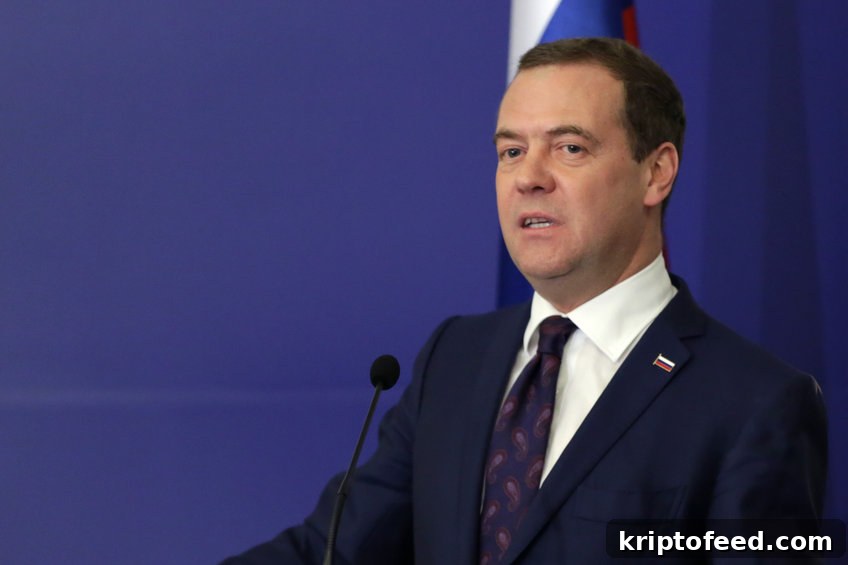
Medvedev is a former Russian president and prime minister and currently serves as Deputy Chairman of the Security Council.
Russia’s proposal to ban cryptocurrencies has sparked reactions from many quarters, with numerous figures voicing opposition for a range of reasons.
Former Russian president Dmitry Medvedev, who also served as prime minister, has joined those who believe that an outright ban would be a poor policy choice for Moscow.
Medvedev currently holds the post of Deputy Chairman of Russia’s Security Council.
In an interview with TASS, he suggested that central bank regulators should find a better approach to managing the issue. He also expressed skepticism that strict restrictions would achieve the regulators’ intended goals.
According to Medvedev, calls from the Bank of Russia to prohibit crypto-related activities could produce outcomes opposite to those desired by authorities.
“To be honest, when you try to ban something, it very often leads to the opposite result,” he told TASS.
Ban would slow innovation and sideline Russia
Medvedev’s remarks came days after President Vladimir Putin asked the central bank and other government agencies to reach consensus on proposed cryptocurrency regulations.
In a report on crypto and related activities released on January 21, the central bank outlined what it described as risks and threats, and proposed a total ban. Under that proposal, activities such as trading, mining and use of cryptocurrencies would be disallowed.
Opposition to the proposed ban has come from multiple quarters, including Maxut Shadayev, the Minister of Digital Development, and Anatoly Aksakov of the State Duma. The Russian Association for Electronic Communications (RAEC) also issued a statement opposing the plans, warning that a ban could push Russia to the sidelines and stifle domestic innovation.
Shadayev warned that a total ban could drive experts and specialists in the innovation sector out of the country. Meanwhile, Aksakov has advocated for legalizing cryptocurrencies while implementing strict government oversight mechanisms for the industry.
Russia is not alone in weighing bans or tighter restrictions on cryptocurrencies.
Earlier this year, India reconsidered draft legislation that would have banned crypto, while China mounted a major crackdown on the sector in 2021. That campaign forced miners and large crypto firms to relocate abroad after authorities banned crypto mining and trading.
The United States has not signaled plans for a nationwide ban, though industry observers say Washington could introduce tougher rules following recent scrutiny of the sector.
Despite regulatory uncertainty, many within the crypto industry and mainstream institutions maintain that cryptocurrencies and the underlying blockchain technology are likely to remain a lasting part of the financial and technological landscape.