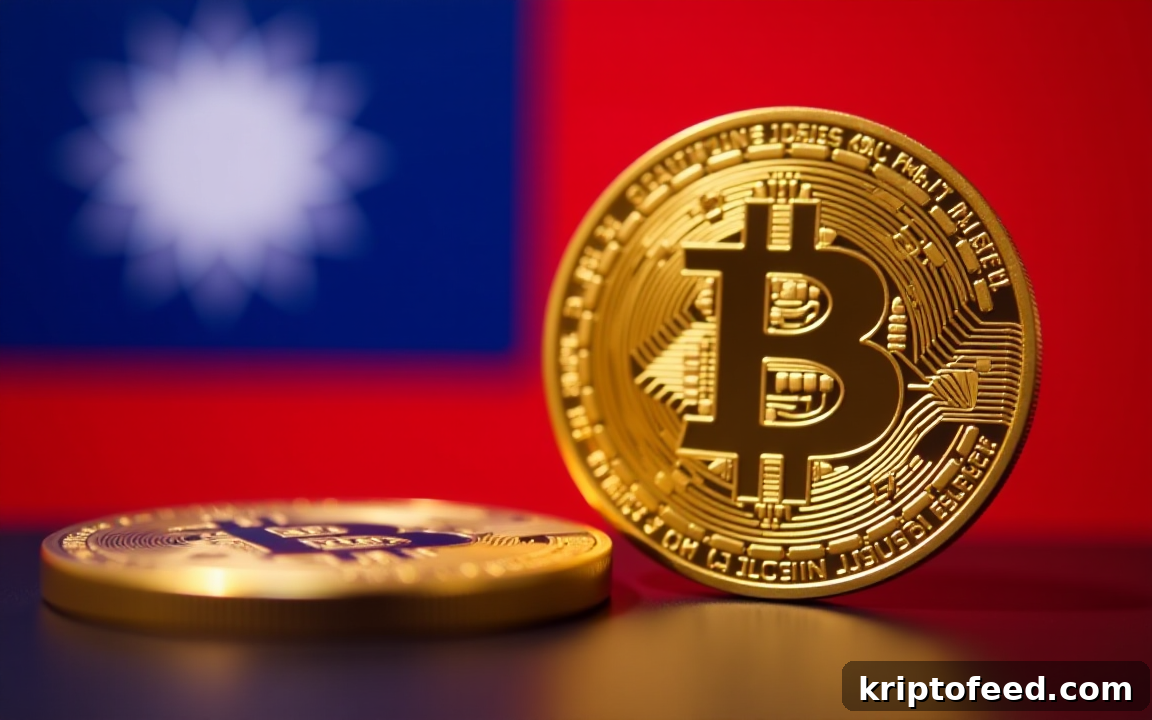
Taiwan is considering a notable policy shift that could see Bitcoin added to its national reserves.
Facing inflationary pressure, global trade tensions, and growing reliance on US Treasury holdings, the country is re-examining whether its financial buffers are truly secure.
Legislator Ko Ju-Chun recently proposed including Bitcoin in the central bank’s reserve mix, citing Bitcoin’s decentralized design and fixed supply as a strategic hedge against future financial instability.
The proposal reflects a broader reevaluation of traditional reserve holdings, particularly since more than 90% of Taiwan’s $577 billion in foreign exchange reserves are currently tied to US Treasuries — raising concerns about diversification and liquidity in times of crisis.
Rising currency risks and dependence on US Treasuries
Taiwan’s export-driven economy is especially vulnerable to geopolitical shifts and inflation trends.
With increasing tensions between the US and China and the risk of supply-chain disruptions, lawmakers are becoming more alert to vulnerabilities in the New Taiwan dollar (NTD).
At present, Taiwan holds 423 tonnes of gold and almost all of its foreign assets in US dollars.
Analysts note that while these holdings have historically been reliable, their heavy concentration exposes the country to US monetary policy and potential sanctions if relations deteriorate.
In a speech to parliament, Ko Ju-Chun argued that Taiwan needs “strategic flexibility” in reserve management, especially in scenarios of financial decoupling or limited access to dollar markets.
Bitcoin proposed as a hedge, not a replacement
The core of the proposal is not to overturn Taiwan’s existing reserve strategy but to diversify it.
Ko’s plan suggests allocating a small portion of Taiwan’s reserves to Bitcoin, which he says would provide a non-correlated asset that is globally accessible and cannot be arbitrarily inflated.
Bitcoin’s fixed supply of 21 million tokens, together with its decentralized ledger system, is a central reason it is being considered.
According to Professor Liu Yiru of National Taiwan University, these characteristics make Bitcoin particularly resistant to inflationary dilution, unlike fiat currencies that central banks can expand during economic shocks.
Former premier Chen also weighed in, noting that while Bitcoin may not serve widely as a transactional currency, its role as a digital store of value could help safeguard Taiwan’s financial sovereignty.
Global momentum for Bitcoin reserves
Taiwan’s deliberations come as other governments experiment with Bitcoin at the state level.
In the United States, New Hampshire recently passed the Bitcoin Reserve Act, allowing the digital asset to be included in state reserves.
The move has sparked debate in other US states and in emerging markets confronting high inflation or currency instability.
Although Taiwan has not yet formalized any such measure, the discussion signals a shift in how policymakers view crypto assets — not solely as speculative instruments but as potential components of national financial infrastructure.
Beyond the legislative proposal, Ko has recommended forming a task force to study the feasibility, volatility, and custody risks of holding Bitcoin in reserves.
The central bank has not publicly responded to the proposal, though the issue is expected to be considered further during upcoming budget and monetary policy reviews.
These debates also take place against the wider backdrop of Taiwan’s need to balance a strong technology sector with the risks posed by its geopolitical position.
Diversifying reserve assets could serve economic objectives while supporting broader strategic autonomy.