
- ETHFI’s price has been swinging wildly amid shrinking liquidity and weak on-chain activity.
- Ether.fi’s daily users have fallen to 328, while protocol fees have dropped by nearly $98,000.
- The price risks deeper losses if the $0.96 support level fails to hold.
Before a sharp rebound attempt, Ether.fi’s native token, ETHFI, plunged earlier today and over the past few days as liquidity thinned and on-chain engagement fell to multi-month lows.
Market analysis and protocol metrics now point to a fragile short-term setup in which technical losses increase concerns about future token supply and declining revenues for holders.
Altcoin sell-off drags ETHFI lower
Risk-off sentiment across broader crypto markets has amplified ETHFI’s downward move.
As traders flee speculative tokens, ETHFI — a high-beta staking play — has underperformed larger names.
The token dropped more than 7.1% to a low of $0.9997 before recovering to around $1.11 at the time of writing, while broader altcoin benchmark indexes show smaller declines, underscoring project-specific pressure.
Market rotation toward Bitcoin (BTC) has accelerated outflows from smaller tokens.
ETHFI’s roughly 33% slide over 30 days signals ongoing selling pressure rather than a single-day repricing event.
Investors treated the token like a leveraged play and exited quickly as macro and micro signals turned negative.
Technical breakdown deepens losses
From a technical perspective, ETHFI fell below the $1.15 midpoint and tested the $0.96 level — the 61.8% Fibonacci retracement — wiping out an early recovery attempt and eroding market confidence.
RSI sits near neutral but trending down, while the MACD histogram continues to support a bearish momentum picture. Some signs of a potential reversal have emerged, but price action during the drop showed seller conviction.
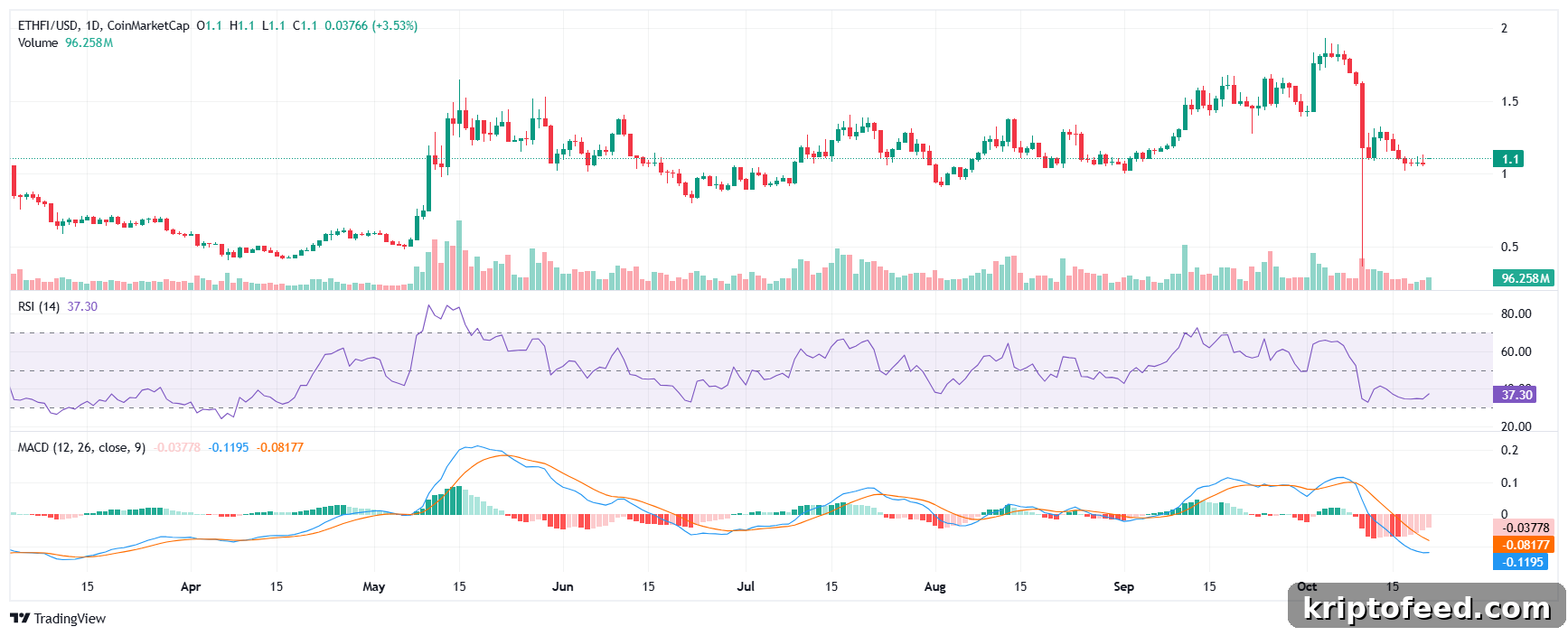
Because algorithms and short-term traders rely on these technical thresholds, breaks often accelerate moves — a pattern evident here.
A close below the $0.96 area would open the door to retesting the September low near $0.80.
On-chain indicators paint a bleak picture
On-chain data confirms price weakness: daily active addresses dropped to 966, the lowest since July 2025, indicating a clear decline in buyer and user engagement.
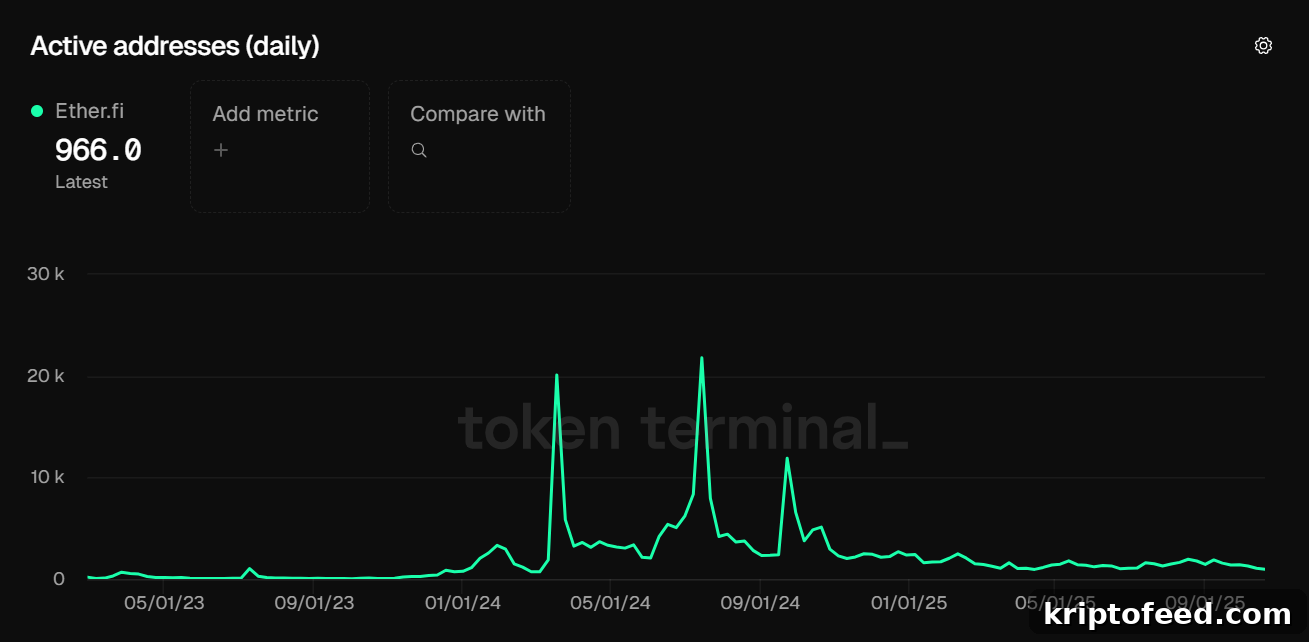
Protocol fees have plunged from roughly $210,500 to about $111,700 — a decline of more than $98,000 that directly hits net holder income and reduces staking attractiveness.
Liquidity has also fallen toward yearly lows, with available DEX liquidity around $680,000.
This thin depth magnifies price moves, as even modest sell orders push the market more aggressively.
TVL has contracted to about $9.784 billion, highlighting waning long-term commitment to the protocol.
Tokenomics and supply remain material risks
Supply dynamics remain a structural risk for ETHFI holders.
Approximately 56% of total supply is already circulating, so upcoming unlock schedules keep potential dilution front of mind for investors.
Fear of future supply increases ahead of major unlock events can trigger preemptive selling, a pattern seen in similar projects.
Net holder income has also dropped sharply quarter-over-quarter: Q4 NHI was near $464,000 versus $3.9 million in Q3, signaling a meaningful decline in protocol revenue and reducing incentives to accumulate or hold.
Without improvements to usage or fee generation, holder economics remain challenged.
ETHFI price outlook
Immediate outlook is skewed to the downside until concrete signs of recovery appear.
Key technical support near $0.96 must hold for any short-term rally to remain plausible.
If that level fails, ETHFI could revisit the $0.80 area where buyers previously defended the token.
Recovery hinges on two factors: sustained on-chain activity and restored liquidity.
A return of daily users and a rebound in fees would stabilize net holder income and improve the token narrative, while meaningful liquidity replenishment would reduce volatility and support price discovery.
Until these changes materialize, traders should expect elevated swings and the possibility of further erosion.