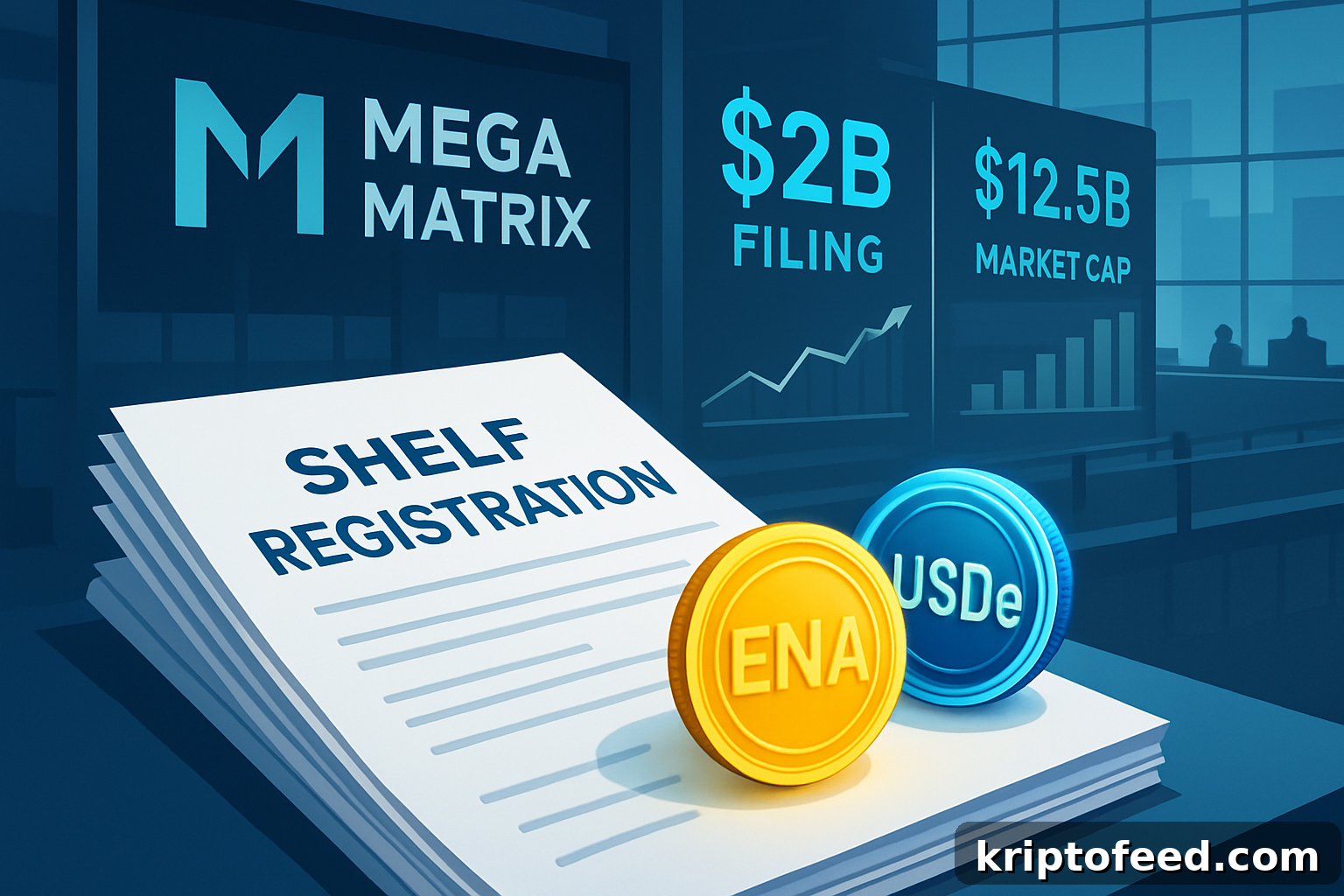
- Mega Matrix files a $2 billion shelf registration to acquire Ethena’s ENA token, betting on the growth of the stablecoin.
- The USDe stablecoin rises to a $12.5 billion market capitalization, generating $500 million in revenue as adoption accelerates.
- Analysts warn of risks tied to yield-producing digital assets, likening them to the CDO products of the 2008 era.
Mega Matrix, a publicly traded holding company originally known for short-form streaming, is making a bold move into managing a treasury of digital assets.
The company filed a $2 billion shelf registration with the U.S. Securities and Exchange Commission (SEC) to support a strategy focused on Ethena’s stablecoin ecosystem—one of the largest filings of its kind for a company of Mega Matrix’s size.
The initiative reflects a broader trend among smaller public companies to diversify into digital assets as part of treasury management, even as the sector continues to face questions about stability and risk.
Increasing exposure to Ethena’s governance token ENA
Mega Matrix said the proceeds from the shelf registration will be used exclusively to acquire ENA, the governance token of the Ethena protocol.
Ethena issues USDe, a synthetic stablecoin designed to maintain a dollar peg through collateralization backed by perpetual futures contracts.
Unlike fiat-backed stablecoins such as USD Coin (USDC) or Tether (USDT), USDe generates yield from funding rates in the derivatives market.
When Ethena’s “fee-switch” mechanism is activated, ENA holders are expected to receive a share of protocol revenue, giving investors indirect access to yield produced by USDe.
By concentrating its exposure on ENA, Mega Matrix aims to capture both governance influence within Ethena and potential revenue upside from the protocol’s business model.
The company cited the rapid rise of Circle, the issuer of USDC, and the increasing role of digital-asset treasuries as drivers behind its decision.
Mega Matrix also pointed to the U.S. GENIUS Act, which restricts issuers from paying yield directly to stablecoin holders, as a regulatory factor pushing demand toward synthetic, yield-bearing alternatives like USDe.
Rapid growth of Ethena in the stablecoin market
Ethena Labs, the developer behind USDe, has seen its protocol expand quickly despite the relative novelty of its model.
In August, the company reported that cumulative gross interest revenues had exceeded $500 million.
According to CoinMarketCap data, USDe reached a market capitalization of $12.5 billion, making it the third-largest stablecoin by market value.
While still much smaller than fully collateralized competitors like USDT and USDC, Ethena’s unique structure and capacity to generate yield have positioned it as an emerging player in the stablecoin landscape.
Investors hunting for stablecoin models that move beyond traditional fiat-backed designs have followed its growth closely.
Risks and industry context
Mega Matrix’s $2 billion registration is noteworthy given the company’s relatively modest market capitalization of $113 million.
The firm reported first-quarter revenue of $7.74 million and a net loss of $2.48 million, with its core business still tied to FlexTV, its short-form streaming platform.
Earlier this year, Mega Matrix also purchased $1.27 million in Bitcoin as part of its gradual shift toward digital assets.
Other companies—including ETHZilla, BitMine Immersion Technologies, SharpLink Gaming, and Bit Digital—have pursued similar treasury strategies focused on cryptocurrencies.
But analysts warn these approaches carry significant risks.
Josip Rupena, CEO of lending firm Milo, compared the engineering of yield-bearing digital assets to collateralized debt obligations (CDOs), instruments that played a central role in the 2008 financial crisis.
He cautioned that investors may not always fully understand the exposures they are taking on.
As Mega Matrix moves forward with its Ethena-centered plan, the strategy highlights both the appeal and the hazards of digital-asset treasuries.
Its outcome will likely hinge on continued growth in USDe and the broader stability of the crypto ecosystem.