
- PancakeSwap (CAKE) has rebounded 1.8% as trading volume surged and short-term momentum improved.
- A governance proposal to reduce CAKE’s maximum supply by 11.1% could support price stability.
- January catalysts include a BNB Chain upgrade and a PancakeSwap AMA that may boost visibility.
PancakeSwap (CAKE) is drawing renewed attention as traders reassess its outlook amid governance-driven supply changes, improving technical indicators, and several January catalysts.
After weeks of selling pressure, CAKE is showing early signs of stabilization, attracting both active traders and longer-term holders looking for clearer direction.
At the time of writing, PancakeSwap (CAKE) was trading near $2.00 following a 1.8% gain over the past 24 hours.
This modest rebound arrives after a 10.29% decline over the past 30 days, underscoring recent volatility in the CAKE market.
Below, we examine how supply dynamics, technical signals, and upcoming ecosystem events could shape PancakeSwap’s price trajectory.
PancakeSwap’s CAKE supply-cut proposal
A key development is PancakeSwap’s governance proposal to lower CAKE’s maximum supply. The plan would reduce the cap from 450 million to 400 million tokens, an 11.1% cut.
This proposal follows Tokenomics 3.0, under which roughly 8.19% of the total supply was burned in 2025. If the new cap is approved, only about 50 million CAKE would remain unminted, markedly reducing future dilution risk.
A clearer scarcity narrative can improve long-term confidence in mature DeFi projects by making token economics more predictable. Market participants expect the governance vote outcome by mid-January, and approval could act as a catalyst for renewed buying interest.
The supply reduction debate also strengthens the SEO story around PancakeSwap, emphasizing supply discipline and sustainable token economics as part of its value proposition.
January catalysts: BNB Chain upgrade and AMA
Several ecosystem-level events in January could influence sentiment toward CAKE. The BNB Chain Fermi hard fork, scheduled for January 14, aims to shorten block times to roughly 0.45 seconds.
Faster block times can improve the efficiency of decentralized exchanges, potentially boosting PancakeSwap’s throughput and user experience. PancakeSwap currently accounts for an estimated 40% of BNB Chain traffic, which could amplify the effect of network improvements.
On the same date, an AMA featuring PancakeSwap will be hosted on Stellar’s channels, increasing cross-community exposure. While AMAs are primarily informational, they help reinforce PancakeSwap’s presence in broader DeFi conversations and can attract new users or liquidity.
Together, infrastructure upgrades and ecosystem engagement provide timely relevance to the CAKE price discussion and may support short-term demand.
Technical rebound and short-term momentum
Technically, CAKE has begun recovering from oversold conditions. The Relative Strength Index (RSI) has risen from below 30 to about 48.5, moving out of deeply oversold territory. On the daily chart, the MACD has produced a bullish crossover and the histogram turned positive for the first time in over a week.
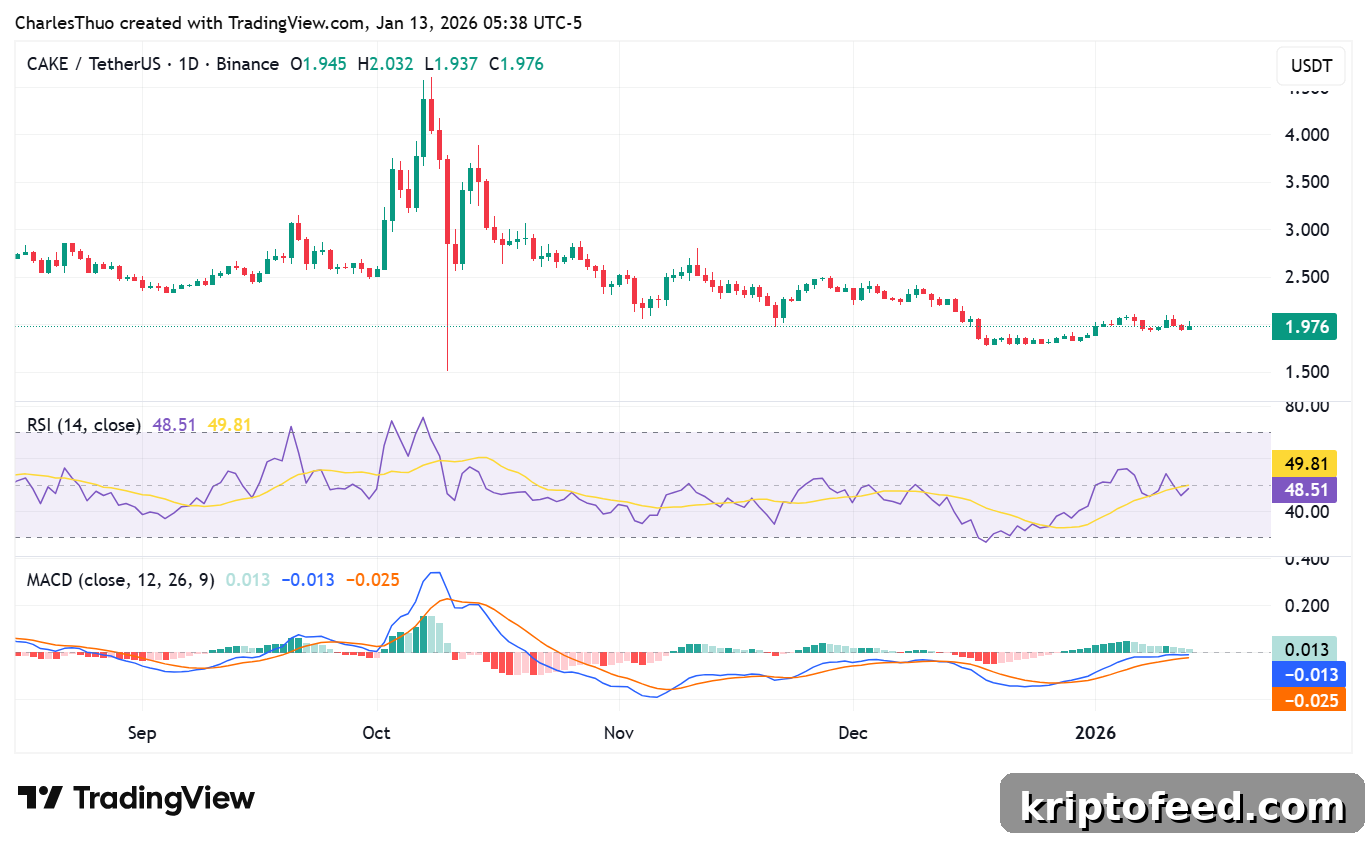
These indicators point to improving short-term momentum, suggesting the market may be ready for a stabilization phase or a gradual recovery if buying interest continues.
PancakeSwap (CAKE) price outlook
The near-term CAKE outlook depends on whether the proposed supply cut, improving technical momentum, and January events align. Approval of the supply reduction would reinforce a scarcity narrative and strengthen the bullish case. Sustained trading volume and holding above the $2.02 level are important for short-term stability.
A decisive breakout above $2.15 could shift momentum toward a short-term bullish continuation, while failure to maintain current levels could open the door to renewed downside pressure. Traders and holders will likely monitor governance outcomes, on-chain activity, and price action closely as these factors develop.