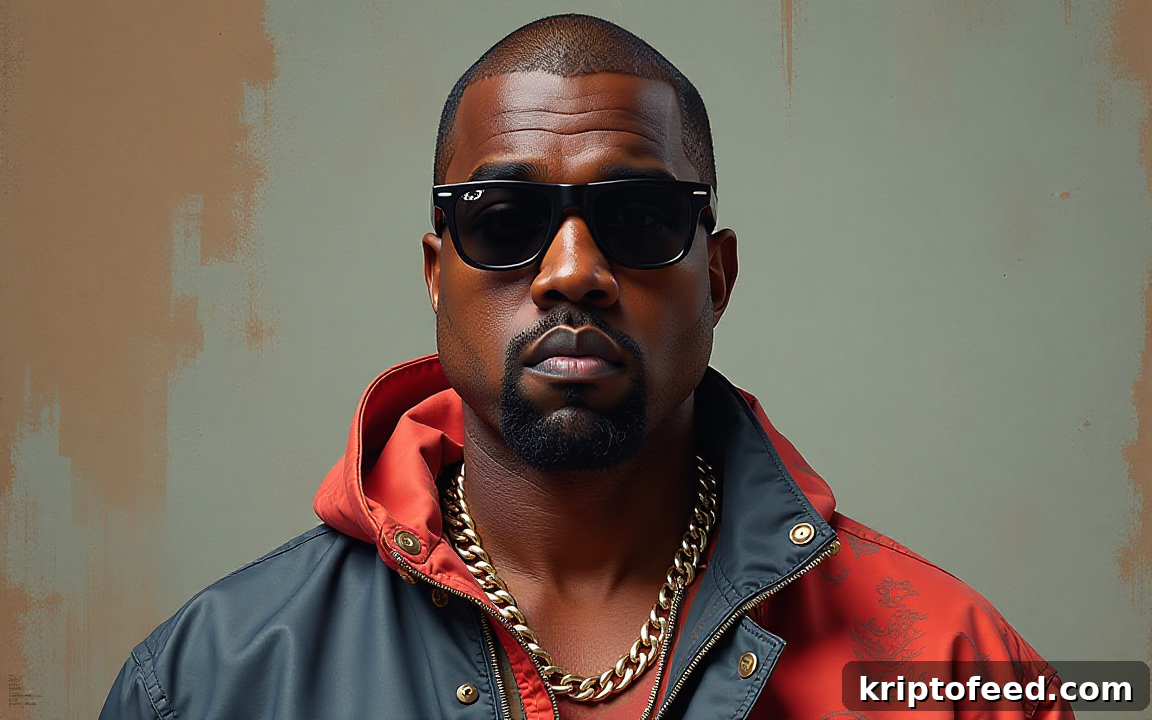
- Yeezy Money (YZY) briefly reached a market cap of $3 billion before crashing more than 60% within hours.
- The top wallets hold nearly 90% of the supply, raising fears of a potential rug pull.
- Insider trades turned $450K into $1.5 million within the launch day.
Kanye West’s bold entry into digital assets took a dramatic turn this week.
His Solana-based cryptocurrency, Yeezy Money (YZY), launched amid heavy promotion and hype that temporarily pushed its market capitalization to $3 billion.
Within hours, however, the YZY token collapsed, leaving investors facing losses exceeding 60%.
The launch combined celebrity influence, technical intrigue and immediate controversy.
Kanye West, who now goes by Ye, used his official account to promote the token with a short clip claiming that “The official Yeezy token has just launched.”
What followed became one of the most volatile trading debuts in recent memory.
From a $3 billion peak to a free fall
Soon after launch, the YZY token soared to a market cap above $3 billion.
At one point it traded above $3 per token, sparking frenzied activity on Solana-based exchanges.
The hype attracted notable crypto figures. Arthur Hayes, co‑founder of BitMEX, publicly admitted he had bought YZY and initially joked that he hoped West wouldn’t “rug” him.
Hours later, as prices collapsed, Hayes conceded he had made a mistake and said he shouldn’t have traded what he called “shitty” tokens like YZY.
Other traders, including leverage specialist James Wynn, also took positions, highlighting how even experienced market participants can be swept up in celebrity-driven mania.
The token’s rally proved short-lived. Within three hours YZY lost more than 65% of its value and fell below $1.20.
By Thursday evening the coin had dropped further. CoinMarketCap showed it trading around $0.99, a 61% decline in a single day.
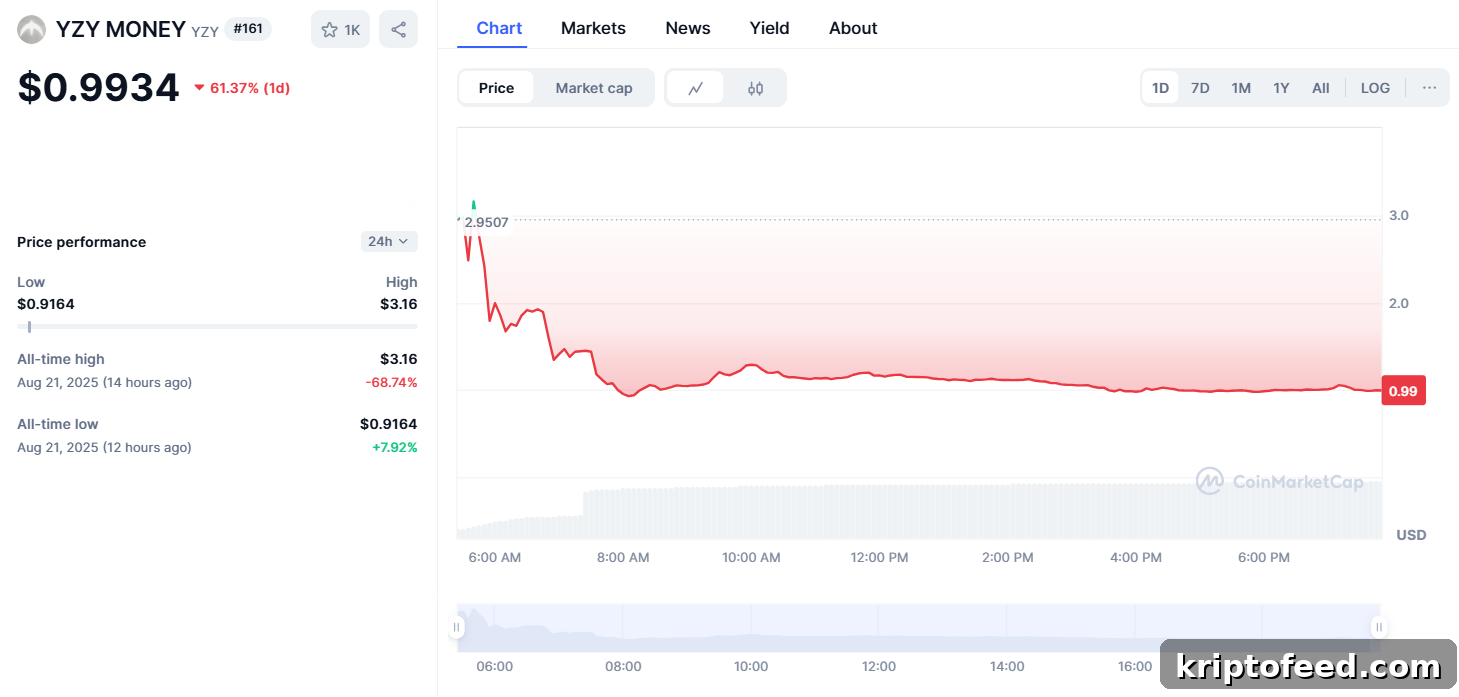
The crash pushed its market capitalization down to roughly $298 million — a tiny fraction of the peak reached only hours earlier.
Trading volume painted the rest of the picture. In the first 24 hours YZY recorded nearly $1 billion in trades, with volume surging more than 37,000%.
For many traders, the swings underscored the risks of a token driven more by celebrity hype than demonstrable utility.
Insider wallets raise alarm
On-chain analysis quickly revealed troubling patterns. Data showed the top six wallets controlled nearly 90% of the total supply.
In fact, a single multisig wallet accounted for 87% of the supply before distribution. That level of concentration prompted warnings of a textbook rug pull scenario.
LookOnChain, a blockchain analytics firm, flagged several wallets that appeared to have privileged access to tokens before public distribution.
An insider reportedly spent roughly $450,000 in USDC to acquire 1.29 million YZY at a low entry price, then flipped holdings for more than $1.5 million within hours.
Retail investors who bought in later experienced a different outcome, with some losing hundreds of thousands after buying into the wrong contract or chasing inflated prices.
Ye’s changing stance on crypto
YZY’s launch drew additional scrutiny because of Kanye West’s past comments on digital currencies.
Earlier this year he dismissed many memecoins as scams that prey on fans through hype.
He even claimed to have turned down a $2 million offer to promote a fake cryptocurrency, warning that such schemes “steal tens of millions of dollars” from the public.
Given that history, his decision to front Yeezy Money surprised many observers.
The official site presented the project as the foundation for a new financial ecosystem, including Ye Pay, a payments processor intended to undercut traditional card networks, and a YZY Card for spending in both crypto and fiat.
The platform described itself as “a new economy, built on a chain,” though critics noted there were few working products to back up those promises.
Despite the turmoil, Yeezy Money produced a cultural moment. Like previous celebrity crypto pushes — from some high-profile NFT drops to token launches by public figures — West’s move underscores the growing intersection of pop culture and digital finance.
Even Solana saw a boost, rising more than 2% as investors chased the hype.