
- Bitcoin currently trades in a tight range near $90,000 amid a three-day streak of ETF outflows.
- The present consolidation mirrors the low-volatility patterns seen before the 2025 surge.
- Key levels to watch include support at $90,000, immediate resistance at $95,000, and $100,000 in the event of a breakout.
Bitcoin (BTC) has been trading in a narrow band around $90,000, reflecting a period of consolidation following a volatile start to 2026. Price action has slowed, with lower intraday swings and a concentrated range that suggests market participants are re-evaluating positions.
Two main forces appear to be shaping the current price behaviour: Bitcoin ETF flows and broader macroeconomic and geopolitical uncertainty. Both factors are influencing investor risk appetite and the willingness of institutions to commit fresh capital to BTC.
Bitcoin ETF outflows weigh on BTC price
Spot Bitcoin ETFs drew strong inflows in early January, signaling renewed institutional interest. That momentum, however, has been partially reversed by a three-day streak of outflows totaling over $1 billion, which has largely offset the earlier gains. This shift suggests that some institutional conviction has softened in the short term.
ETF redemptions have been an important driver of Bitcoin’s recent inability to clear the $95,000 level. Traders are increasingly cautious amid geopolitical tensions involving the United States, several Latin American countries, and Iran, as well as a broader risk-off sentiment across global markets. These factors collectively weigh on demand for risk assets, including cryptocurrencies.
It’s important to note that current ETF outflows may represent tactical reallocations rather than wholesale liquidation. Some investors could be shifting capital among different strategies or assets while maintaining overall exposure to Bitcoin. Even so, the near-term selling pressure has kept BTC constrained to a range roughly between $88,000 and $95,000.
Echoes of pre-2025 rally patterns
The present sideways trading environment resembles the consolidation phase observed in the months before Bitcoin’s 2025 rally. Back then, BTC spent weeks in a tight range—an episode often described as time-based capitulation—during which weaker hands exited and the market digested previous gains. That process helped set the stage for the subsequent powerful upward move.
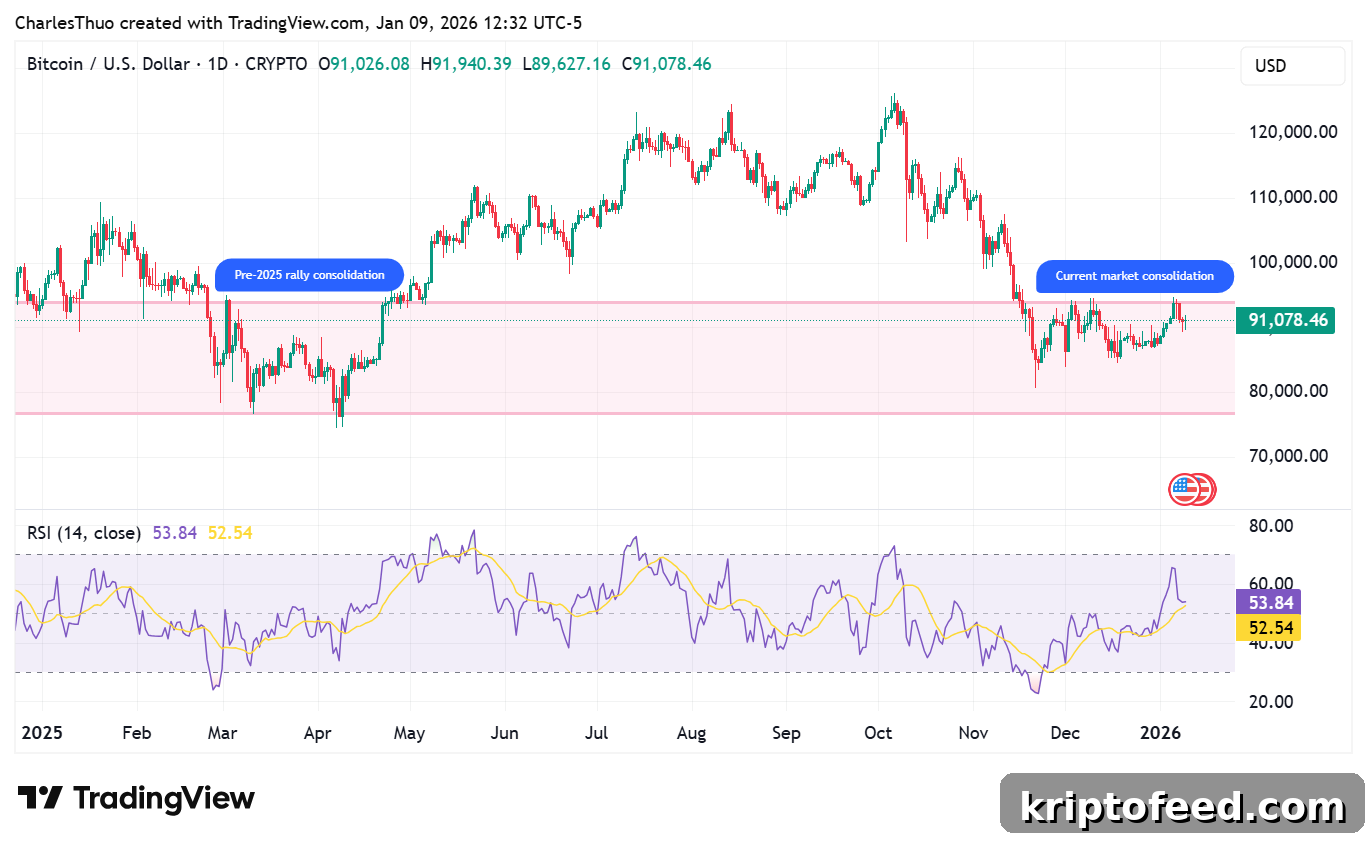
Unlike abrupt capitulation episodes that feature panic selling and sharp drawdowns, this phase is characterized by low volatility and steady range-bound trading—conditions that can allow accumulation by longer-term holders. Some analysts interpret such quiet periods as a sign that the market is building momentum under the surface, with temporary headwinds—like ETF outflows and geopolitics—merely delaying a potential breakout.
If historical patterns hold, a decisive breach of key resistance could attract renewed buying and trigger a more sustained upward move. Conversely, failure to hold critical support would raise the risk of deeper retracement before any new leg higher.
The key Bitcoin price levels to watch
Market participants should monitor several technical levels that could determine the next directional move. Immediate support sits near $90,000; a break below that level could expose BTC to declines toward the $86,000–$88,000 area. Traders should watch volume and order flow closely if price approaches those levels, as increased selling could accelerate downside momentum.
On the upside, a sustained move above $95,000 would likely signal renewed institutional demand and could pave the way for faster gains. Clearing and holding above $100,000 would be an even stronger confirmation of bullish conviction and could prompt the market to revisit mid-2025 highs, with $110,000 as a potential medium-term target if momentum builds.
Going forward, investors and traders should combine technical analysis with attention to macroeconomic and geopolitical developments to assess timing and magnitude of any future breakout. ETF flows, central bank policy shifts, and major geopolitical events will likely remain important catalysts that can either accelerate or hinder Bitcoin’s next move.