
- Outflows from Bitcoin ETFs and shrinking liquidity have intensified the recent BTC price decline.
- Margin liquidations accelerated selling and caused key support levels to break.
- Correlation with tech stocks added pressure amid a broader risk-off sentiment.
Bitcoin has faced a sharp market headwind in recent weeks as weakening demand, large ETF outflows, and waves of forced liquidations combined to push the price significantly lower.
This decline erased months of gains and left traders wondering whether the move represents a temporary pullback or the start of a deeper cycle reset.
ETF outflows have exacerbated the sell-off
The drop in Bitcoin has been steep and persistent since the early October peak above $126,000.
Since that high, the crypto market has lost roughly $800 billion in value, pulling prices back to levels seen earlier in the year.
ETFs, which had once helped stabilize BTC, are now a source of added weakness.
BlackRock’s IBIT fund — previously a buyer that absorbed selling — suffered $520 million in outflows, marking the largest monthly redemption for the fund.
That shift signals changing institutional sentiment and has become a meaningful source of downward pressure.
Recent research from NYDIG highlighted that ETF outflows, declining stablecoin supply, and shifts in corporate treasury strategies have eroded the demand drivers that supported Bitcoin earlier this year.
NYDIG’s Greg Cipolaro described the current cycle as a “negative feedback loop”: forces that once drove the market higher are now amplifying the downturn.
As a result, Bitcoin faces persistent selling pressure and a reduction in risk appetite.
A key example of this change is the stablecoin market, where supply has fallen for the first time in months and some tokens have lost significant value following liquidations.
Digital asset treasuries that were once active buyers are also retreating, selling assets or reducing liabilities through buybacks, which further drains liquidity across the crypto sector.
Bitcoin price outlook
From a technical perspective, Bitcoin plunged into oversold territory, printed a hammer candle, and signaled a potential swing low.
Attention has centered on the $88,500 level, which has capped the earlier rally this year and temporarily halted last week’s selling.
A sustained move above $88,500 would set the stage for a short-term recovery, with a potential target zone near $94,000–$95,000.
However, any recovery faces strong resistance from broader market sentiment.
The tight relationship between Bitcoin and risk assets adds another layer of complexity.
Correlation between Bitcoin and Nasdaq 100 futures has climbed to unusually high levels, approaching roughly 0.96.
When tech stocks decline, Bitcoin tends to follow, and recent concerns about an AI-led bubble have weighed on both markets.
Bitcoin dominance has also dipped to multi-month lows, indicating capital is shifting away from BTC toward perceived safe havens and other high-risk alternatives.
Volatility from margin liquidations has further amplified moves.
Highly leveraged positions in futures amplified recent price swings. When Bitcoin slipped below $87,000, more than $900 million in positions were wiped out, with longs bearing the brunt.
Liquidation cascades have repeatedly deepened each successive leg of the sell-off.
Momentum indicators such as the relative strength index (RSI) and moving average convergence divergence (MACD) remain bearish, suggesting past bounces were quickly sold into.
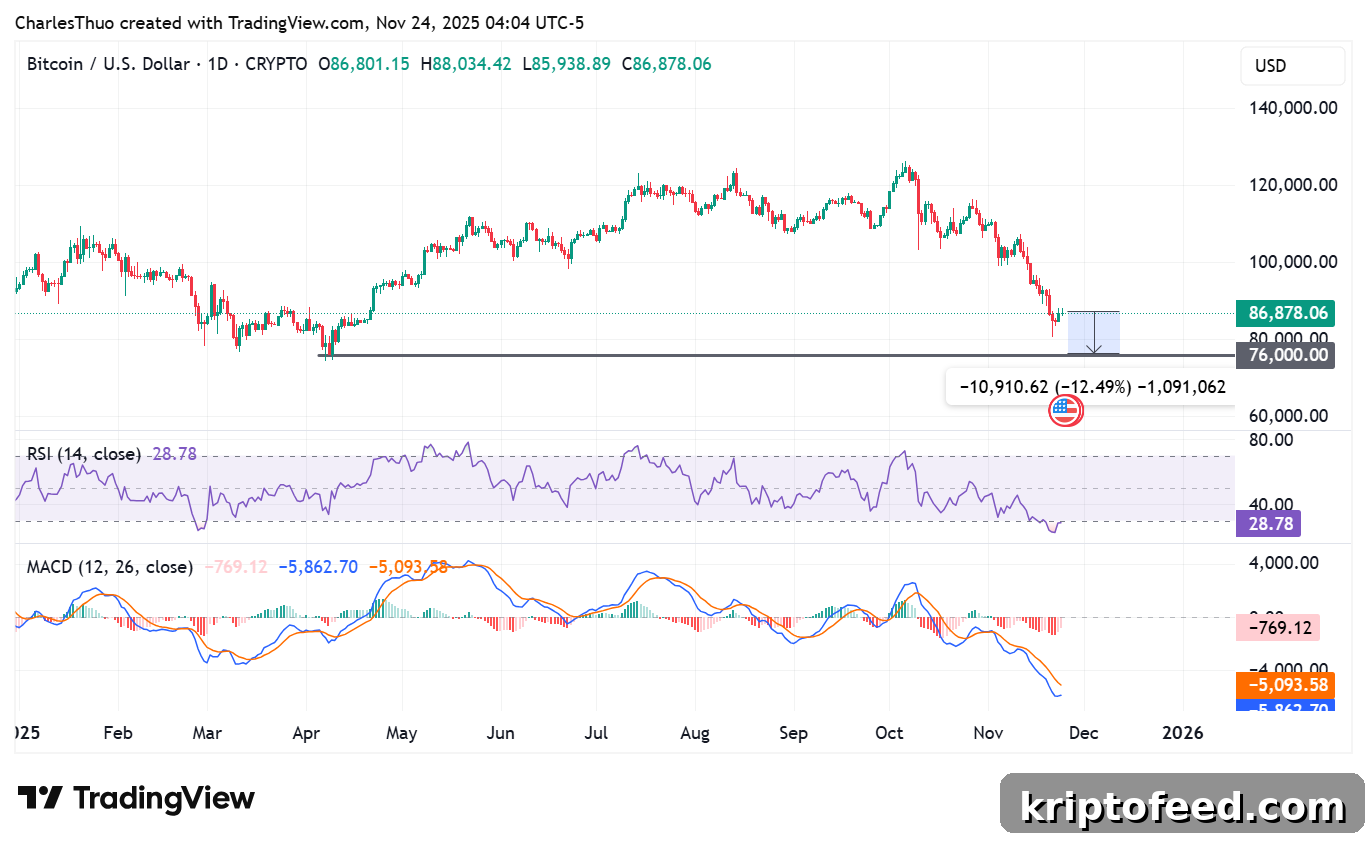
If the recent lows are breached, a market shock tied to tariff concerns and broader risk-off dynamics could open the door to a re-test of the roughly $76,000 area.