
- Bitwise has filed an S‑1 registration statement for an ETF that would track HYPE.
- If approved, it would be the first ETF tied to a perpetual decentralized exchange token.
- Regulatory approval could send Hyperliquid’s native token to new highs.
$15 billion asset manager Bitwise appears to be positioning itself for the next wave of digital finance. The firm has submitted an S‑1 with the U.S. Securities and Exchange Commission seeking approval for an exchange‑traded fund (ETF) that would provide exposure to Hyperliquid’s native coin, HYPE.
The S‑1 filing has attracted attention because a HYPE ETF would be unprecedented: it would offer regulated, mainstream access to a token whose primary utility is rooted in a perpetual decentralized exchange. Such a product would mark an important step in bringing more complex DeFi tokens into traditional investment channels and would reflect growing institutional interest in alternatives beyond Bitcoin and Ethereum.
Understanding Hyperliquid
Hyperliquid is a decentralized protocol engineered around perpetual futures (perps) trading. Unlike many blockchains that target multiple use cases, Hyperliquid focuses specifically on high‑frequency perpetual derivatives, a market segment that has drawn strong interest from traders seeking continuous exposure without expiry dates.
Perpetual contracts allow market participants to speculate on an asset’s future price with no set settlement date, enabling levered positions and active trading strategies. That feature, combined with Hyperliquid’s emphasis on low latency and high throughput, has helped the platform carve out a niche in the DeFi ecosystem.
Bitwise’s decision to pursue a HYPE ETF signals confidence in both the underlying technology and Hyperliquid’s role in decentralized finance. An ETF approval would broaden access to HYPE through a familiar, regulated wrapper, giving a wide array of U.S. investors exposure without the technical hurdles of self‑custody and direct DEX interactions.
Institutional investors such as pension funds and hedge funds, as well as retail brokerage accounts, would be able to gain regulated exposure to HYPE via brokerage platforms and custodial services. This could lower the friction for mainstream investors who have been hesitant to interact with decentralized exchanges and on‑chain derivatives markets directly.
Challenges ahead
Despite the excitement, approval is far from guaranteed. The SEC has historically taken a cautious stance toward cryptocurrency ETFs and frequently raises concerns around investor protection, liquidity, custody, and market manipulation. Those considerations are especially acute for a token whose primary use involves perpetual trading, a product with heightened leverage and counterparty complexity.
Bitwise’s filing arrives while the SEC continues to review and, in some cases, delay decisions on several altcoin ETF applications. The regulator’s scrutiny of other spot and alternative asset ETF proposals underscores the uncertain timeline and regulatory risk Bitwise faces.
The SEC will likely weigh the potential benefits of increased investor access against risks unique to perpetual‑focused tokens, including price volatility, liquidity concentration, and operational risks tied to the underlying DEX infrastructure. Balancing investor safety with innovation will be a central theme during the review process.
HYPE price action
At the time of reporting, HYPE traded down roughly 0.2% over the prior 24 hours, near $42.43. The token has retreated from mid‑September all‑time highs around $58 and currently reflects broader market weakness across digital assets.
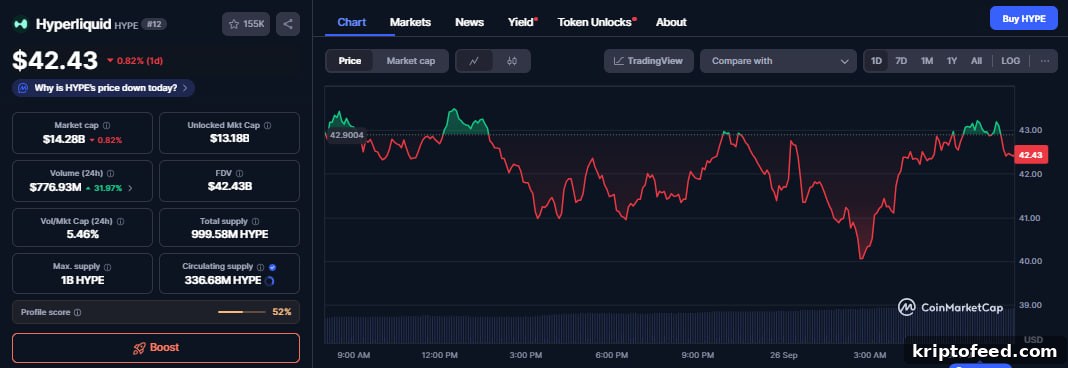
Marketwide selling pressure followed macroeconomic news revisions, and the broader crypto market moved lower after updated U.S. GDP data was released. Bitcoin and other major coins have shown subdued price action, and HYPE’s decline mirrors the industry’s short‑term trend as investors digest both macroeconomic signals and regulatory developments.
Overall, Bitwise’s S‑1 filing for a HYPE ETF is a notable development for the intersection of DeFi and regulated finance. If the SEC approves the product, it could open a new channel for mainstream investors to access a token tied to perpetual trading, potentially increasing liquidity and driving significant price discovery. However, regulatory hurdles remain substantial, and market participants should weigh both the potential upside and the risks associated with a novel ETF built around a high‑frequency decentralized asset.