- With the team releasing a 2026 roadmap, Aster’s price could rebound by more than $1.
- After the decentralized exchange outpaced peers, the token once reached a high of $2.42.
- Aster is planning a testnet, real-world asset upgrades, and native token staking.
The decentralized exchange token Aster has recently traded up to $1.04, recovering from a low of $0.88.
Although DEX tokens fell roughly 2% over the past 24 hours, buyers may seek new upside following the Aster team’s announcement of the highly anticipated first half 2026 roadmap.
The roadmap’s ambitious goals—focused on infrastructure, token utility, and community engagement—have renewed market interest in the token’s price potential.
It’s important to note these new network objectives come after a year of notable progress for Aster.
Aster outlines its 2026 roadmap
Although Aster is a relatively new project in the market, it has built a robust ecosystem and an active community.
Partnerships and a targeted buyback program have supported ASTER’s price, and on December 4 the team shared the upcoming roadmap.
Plans for perpetual options and spot trading platforms are set to produce a sequence of milestones beginning in late 2025.
Early December will introduce a shield mode for private high-leverage trades and TWAP (time-weighted average price) strategy orders.
Mid-December will see an upgrade to real-world asset (RWA) trading, with liquidity depth focused on stock perpetuals, followed by the launch of the Aster Chain testnet at the end of the month.
In 2026, the Aster Chain Layer 1 (L1) mainnet is slated to go live. The planned first-quarter launch will include fiat on- and off-ramps and the Aster Code platform for developers.
According to the project, the second quarter will introduce ASTER staking, on-chain governance, and smart capital tools that allow users to mirror top traders’ strategies.
The team wrote: “2025 was proof that Aster can deliver: we merged Astherus with ApolloX, launched multi-asset margin, released a mobile app, completed the TGE, listed on major CEXs, and rolled out hedge mode, trade-and-earn, a buyback program, and more. Now we’re doubling down on three core engines—infrastructure, token utility, and ecosystem & community—so they reinforce one another and create a sustainable flywheel.”
Aster views this multi-pronged approach as essential to building a scalable network that evolves with user needs and commitments.
What could this mean for Aster’s price?
The disclosure of Aster’s roadmap for Q1 and Q2 2026 sparked renewed speculation about the token’s potential price impact.
From a technical perspective, the DEX token looks poised for upside, having broken out from a key downtrend line on the daily chart.
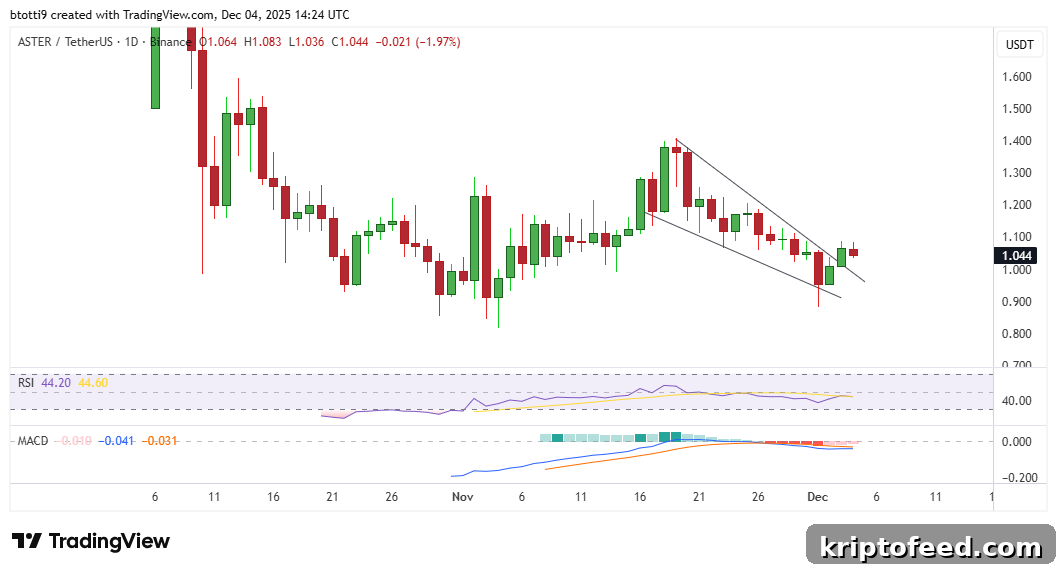
The Aster price chart shows key technical levels and recent breakout activity.
Daily RSI and MACD indicators still show bearish tendencies, suggesting momentum is not yet decisively bullish.
However, if price holds above the downtrend line, renewed momentum could push bulls toward an initial target near $1.38. A sustained move higher could open the path to $1.50 and then $2.06, setting the stage for a challenge to the prior all-time high.
Conversely, if bullish momentum fades, sentiment could flip and push the price back toward the $0.81 support area.
Investors should weigh roadmap progress, on-chain developments, and macro market conditions when assessing Aster’s outlook. Technical signals indicate both upside potential and downside risk, making clear milestones—from the testnet to mainnet and staking—key catalysts to monitor.