
Technical analysis is the primary tool investors use to estimate where cryptocurrency prices are headed.
When combined with solid fundamental analysis, it can help plan trades, limit risk, and improve results. Different indicators and signals perform better depending on the market sector and current conditions.
This article examines four popular technical indicators for analyzing cryptocurrencies.
Moving averages
In a market as volatile as cryptocurrencies, it’s important to have a visual representation of the broader trend. A standard candlestick chart is often not enough to provide the clearest overview of price action. That’s where moving averages come in. There are several types, but the most common is the Simple Moving Average (SMA), which represents the average price over a defined period.
These averages are calculated by summing the closing prices over a timeframe and dividing by the number of periods. The resulting line gives a general indication of the expected trend: an upward-sloping SMA suggests a potential uptrend, while a downward slope suggests a downtrend. Common SMA timeframes are 50, 100, and 200 days (SMA50, SMA100, and SMA200), which offer insight into short-, mid-, and long-term price behavior.
Before applying them to a chart, the data is typically configured in daily intervals. Note that long-term moving averages like the SMA200 require at least a year of historical data, so very new cryptocurrencies cannot be analyzed effectively using long SMAs.
Moving averages therefore work better for established coins such as Bitcoin or Ethereum that already have significant price history.
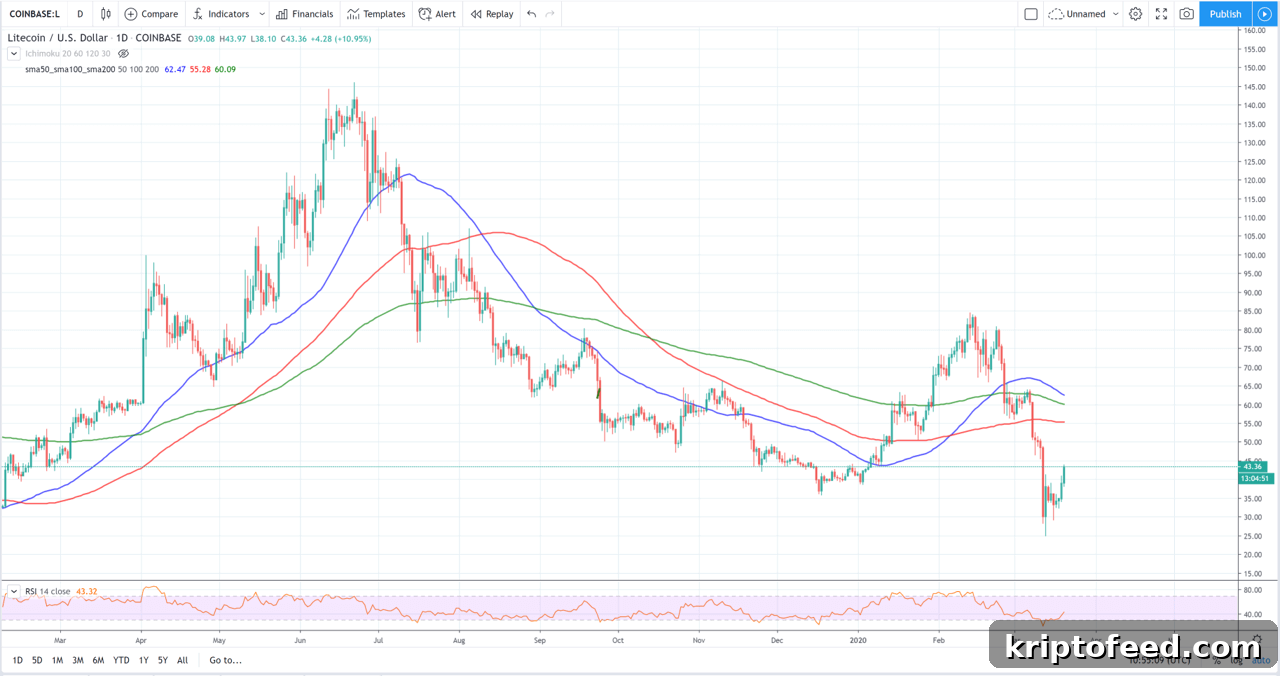
To view multiple timeframes, traders commonly plot several moving averages on the same chart. It’s important to recognize and understand each line before relying on them. In the example above, the Litecoin vs USD chart shows three moving averages: blue (SMA50), red (SMA100), and green (SMA200).
Moving average crossovers
One advantage of displaying multiple moving averages on a single chart is the ability to spot crossovers.
Crossovers are widely used by professional traders and can be very effective; they often signal trend changes and can act as strong bullish or bearish trade signals.
The most watched crossovers are between the SMA50 and the SMA200:
- Death Cross: occurs when the SMA50 crosses below the SMA200. It is a bearish signal that typically indicates increasing selling pressure.
- Golden Cross: occurs when the SMA50 crosses above the SMA200. This bullish signal suggests buyers are entering the market and prices may rise.
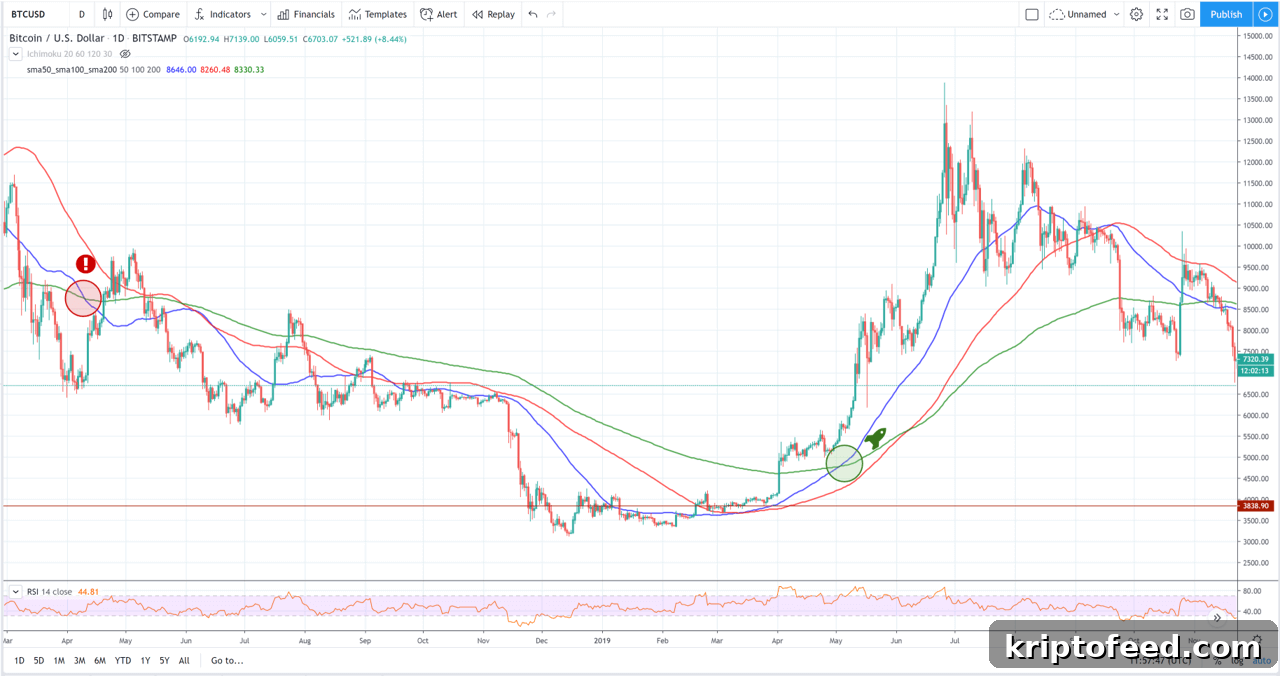
The candlestick chart above for Bitcoin shows both a golden cross and a death cross, illustrating how useful these indicators can be for detecting early trend shifts in medium-term price action.
RSI — Relative Strength Index
The Relative Strength Index (RSI) is one of the most important and powerful indicators for analyzing financial assets. Fidelity describes it as:
“The Relative Strength Index is a momentum oscillator that measures the speed and change of price movements.”
RSI is expressed as a percentage between 0 and 100. Besides indicating momentum and trend strength, the RSI is commonly used to identify when an asset may be overbought or oversold.
When RSI rises above 70, the asset is often labeled overbought, which can signal a potential sell-off.
In other words, if buyers have been too aggressive and buying power becomes exhausted, the market may experience a downward technical correction—an opportunity traders may exploit when opening short positions or taking profits.
When RSI falls below 30, the asset is considered oversold, which can suggest a potential rebound or reversal. These thresholds are guidelines; some analysts prefer more extreme levels such as 80 and 20. In strong trends, RSI can remain in overbought or oversold regions for extended periods.
Depending on the chart timeframe, RSI can reflect short- or long-term conditions. It is typically more meaningful on charts longer than four hours.
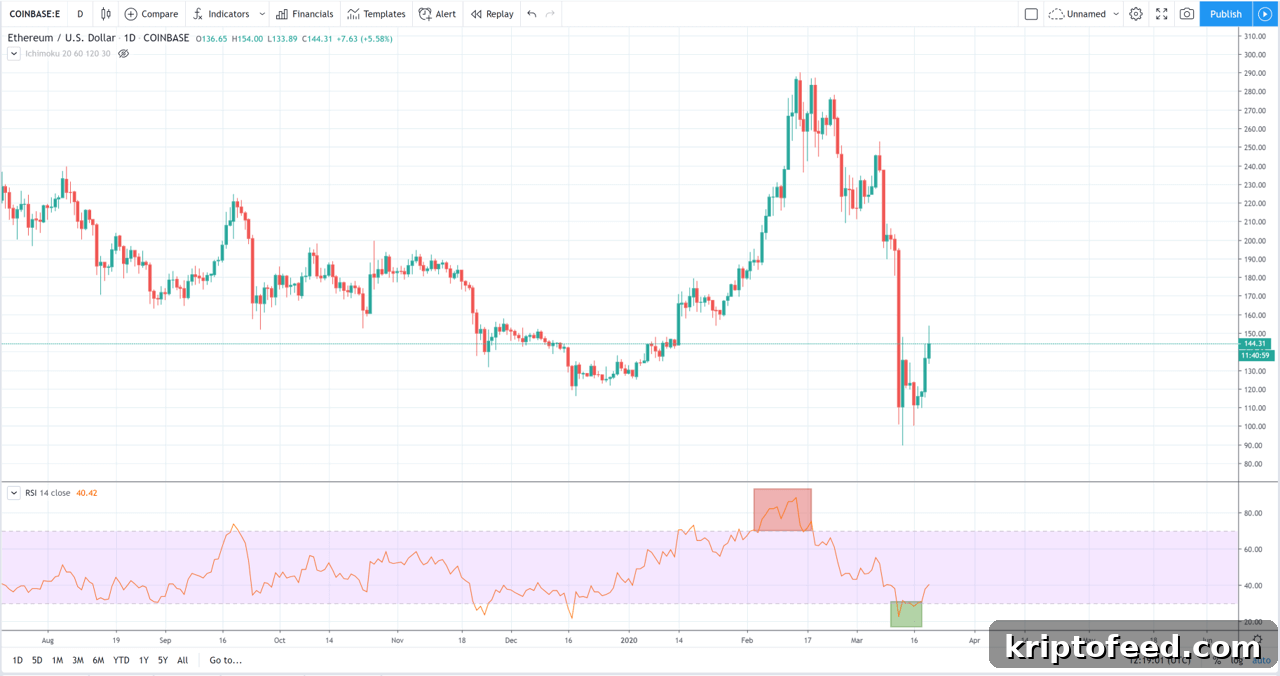
The RSI is straightforward to read and analyze. In the daily Ethereum chart above, you can clearly see the RSI entering overbought and oversold zones, with fairly consistent price reactions following those signals.
Volume and order books
Buy and sell volume helps identify bullish or bearish price moves. Volume indicators are more reliable when sourced from high-liquidity exchanges and can offer crucial context for price changes.
Order books provide real-time information about the concentration of limit buy and sell orders. They reveal potential buy and sell walls that can act as support or resistance levels, influencing where prices may move next.
However, these data should not be treated as absolute truth, especially in rapidly evolving and volatile markets.
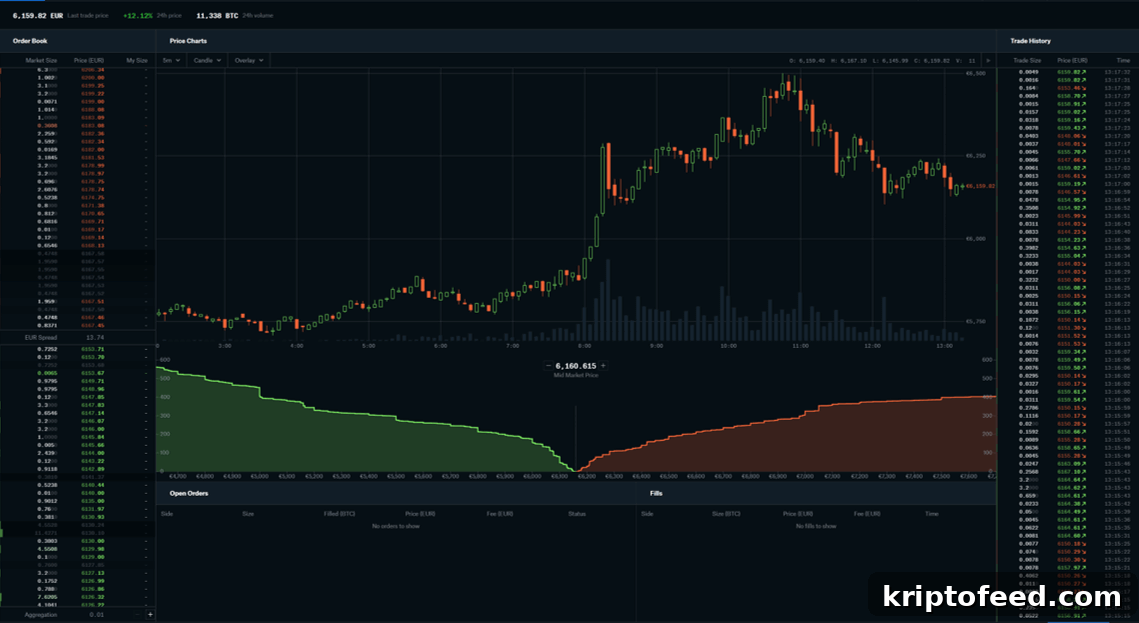
Platforms like Coinbase Pro display a live order book with a depth chart, allowing you to spot unusual volume concentrations at specific prices—potential signs of institutional interest or significant market intent.
Other useful indicators
There are many other technical and fundamental indicators that can complement your analysis and improve trading outcomes. For further reading on complementary signals and fundamentals, consult guides that focus on identifying when a cryptocurrency may be poised for a significant move.
Where can you view and analyze these charts?
TradingView is the leading platform for technical analysis, but many exchanges and brokers offer their own charting tools, volume data, and order book views. Popular platforms typically provide the indicators and real-time data traders need to evaluate market conditions.