
The push toward decentralization accelerated after Bitcoin demonstrated the benefits of a system not governed by a single authority. From that evolution emerged Decentralized Finance, commonly called DeFi, which extends the promise of cryptocurrencies by simplifying and democratizing financial services. DeFi replaces cumbersome, centralized processes with accessible, blockchain-based alternatives. Below, we review four leading cryptocurrencies that play central roles in the DeFi ecosystem.
What is DeFi and how does it relate to cryptocurrencies?
Decentralized Finance, or DeFi, broadly describes open ecosystems that enable the creation of decentralized financial tools, applications, and services. DeFi builds on the core ideas of cryptocurrencies by offering alternatives to conventional financial services, including savings, lending, trading, insurance, and custody.
Unlike services controlled by a single company or intermediary, many DeFi solutions run on decentralized technologies such as blockchains or other distributed ledgers. These architectures allow participants to interact without centralized gatekeepers, making DeFi projects more transparent, permissionless, and innovative.
DeFi systems typically combine blockchain infrastructure with smart contracts, decentralized applications (dApps), and specialized protocols. Together, these components make it possible to access financial services—like obtaining loans without traditional banks or exchanging assets with minimal fees—in a more direct, programmable way. The following cryptocurrencies have been instrumental in bringing these capabilities to life.
Ethereum: the cornerstone of DeFi development
Ethereum’s introduction of smart contracts and its open platform for launching new tokens and projects have made it the principal foundation for most DeFi innovation. As the cryptocurrency with the second-largest market capitalization, Ethereum’s ecosystem hosts a significant portion of industry tokens and projects.
Ethereum’s standards, particularly ERC-20, enabled developers to create thousands of tokens and decentralized applications. A large share of DeFi protocols—lending platforms, decentralized exchanges, stablecoins, and automated market makers—were first built on Ethereum because of its mature tooling and developer community.
Ongoing upgrades to Ethereum aim to improve scalability and performance, which should further strengthen its role in DeFi by enabling higher throughput and lower fees. The network’s widespread adoption and programmatic flexibility keep it at the center of decentralized finance.
- Quick tip: Cryptocurrency tracking sites often include filters to view DeFi tokens specifically. Using those filters can help you follow projects focused on decentralized financial services.
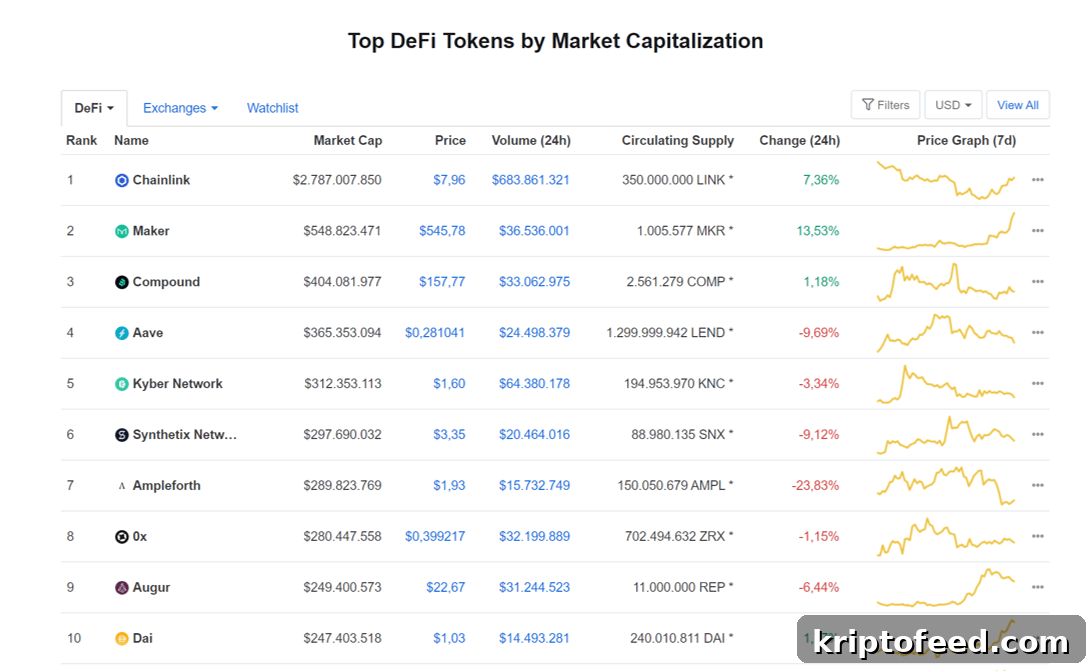
MakerDAO: decentralized stability for a stablecoin
MakerDAO and its DAI stablecoin demonstrate how a decentralized governance model and robust smart contracts can maintain price stability without relying on centralized banks. Instead of backing each token with fiat reserves held by a custodian, MakerDAO uses collateralized positions and incentive mechanisms to keep DAI pegged to the U.S. dollar.
Through a system of collateralized debt positions, automated liquidation rules, and governance by MKR token holders, MakerDAO offers a decentralized approach to issuing and stabilizing a widely used stablecoin. This architecture highlights how complex financial logic can be encoded on-chain to replace traditional intermediaries.
Compound: DeFi lending and borrowing made simple
Compound is a prominent example of how DeFi can transform lending. The protocol provides a dApp where users can supply crypto assets to earn interest or borrow assets by posting collateral. Interest rates are algorithmically adjusted based on supply and demand, eliminating the need for intermediaries and enabling peer-to-peer liquidity markets.
Lenders earn passive income by supplying assets to Compound’s liquidity pools, while borrowers gain access to loans secured by crypto collateral. By automating rate adjustments and collateral management through smart contracts, Compound offers a transparent, permissionless lending market that operates 24/7.
Chainlink: connecting smart contracts to real-world data
Chainlink focuses on a crucial DeFi problem: reliable access to off-chain data. Chainlink’s oracle network enables smart contracts to securely interact with external data sources, APIs, and traditional systems. That capability allows DeFi applications to use price feeds, external events, and other real-world inputs while preserving on-chain trustlessness.
By providing tamper-resistant, decentralized oracles, Chainlink helps projects avoid single points of failure when they depend on external information. This bridging role has made LINK one of the most notable tokens in DeFi by market capitalization, and it plays an important infrastructure role across many decentralized applications.
Chainlink’s prominence in DeFi rankings has sparked debate in some circles, but the network’s fundamental value lies in enabling smart contracts to act on reliable, externally sourced data—an essential feature for many advanced financial use cases.